of the rudraksha Nepal exported between mid-July 2024 and mid-February 2025 went to India (475,776 of 684,909 kg), at an average declared value of just NPR 57 (about ₹36) per kilogram.
Source: Nepal Department of Customs figures for FY 2081/82 as reported by Global Voices (March 2025); share and per-kg value calculated by Nama Veda, September 2026.
- 69.5% to India, 30.5% to China: of 684,909 kg exported in the first seven months of FY 2081/82, 475,776 kg went to India and 208,966 kg to China (Global Voices, 2025).
- NPR 57 per kg: the average declared export value in that period (NPR 39,146,000 ÷ 684,909 kg) — about ₹36/kg at the NRB peg of ₹100 = NPR 160 (Nepal Rastra Bank).
- −52% in two years: the declared value of China-bound rudraksha fell from NPR 195/kg in FY 2018/19 to NPR 93/kg in FY 2020/21 (Dialogue Earth, 2022).
- 2 of 14: the popular deity pairings for 7 Mukhi (Mahalakshmi) and 8 Mukhi (Ganesha) appear in neither the Shiva Purana nor the Rudraksha Jabala Upanishad (Shiva Purana 1.25).
- 0 of 14: neither text assigns a ruling planet to any mukhi; planetary rulers are a later astrological layer (Rudraksha Jabala Upanishad).
- NPR 150–200 million vs NPR 1 billion: two 2025–26 reports on Bhojpur’s annual rudraksha trade differ by at least 5x (Singhadarbar, 2025; Ratopati, 2026).
- 14x: one certified 5 Mukhi bead at ₹499 retail is priced about 14 times the average declared customs value of a whole kilogram of exported Nepali rudraksha (Nama Veda calculation).
Table of Contents
What does “mukhi” mean in Rudraksha?
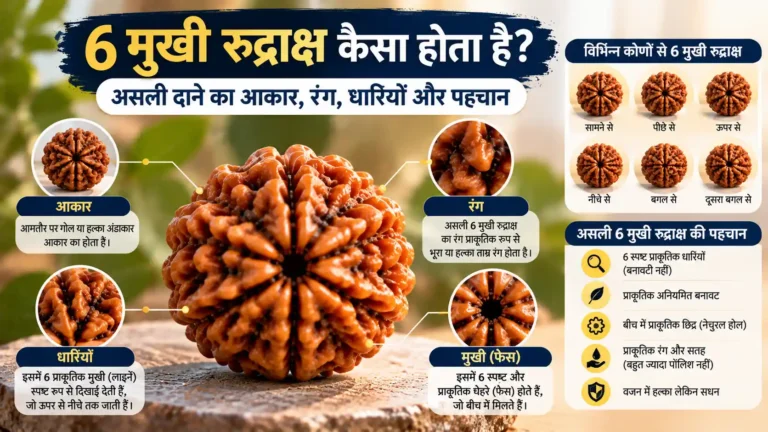
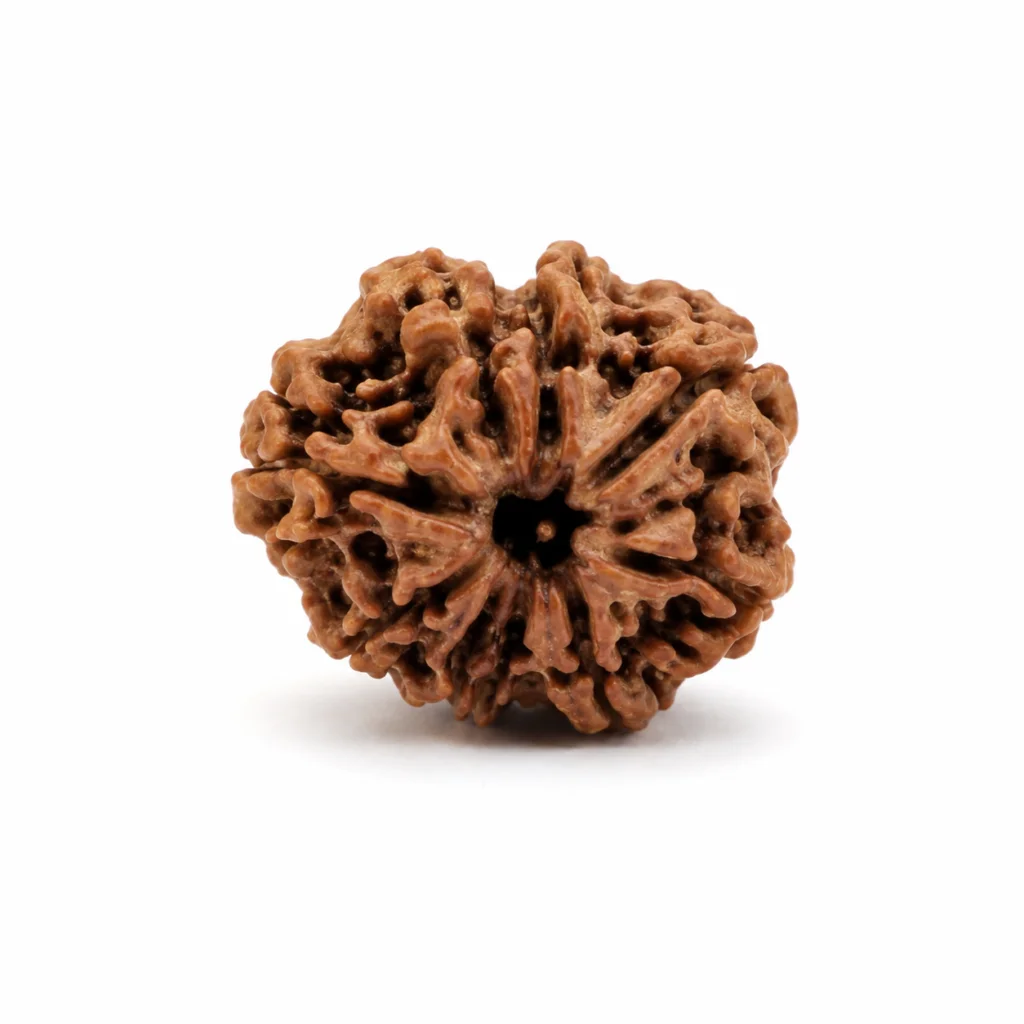
A mukhi is a natural groove running from the top to the bottom of a Rudraksha bead, and the number of grooves decides the bead’s name. A bead with five grooves is a 5 Mukhi Rudraksha. Each groove usually matches one internal seed chamber, which is why lab X-rays are used to confirm the count.
Botanically, the bead is the stone (endocarp) of Elaeocarpus angustifolius. The name most sellers use, Elaeocarpus ganitrus, is listed as a synonym of E. angustifolius in the eFlora of India database, which records the tree from India, Nepal and China through Southeast Asia to Australia. Ripe fruits are blue, and the wrinkled stone inside is what is dried and sold.
The Shiva Purana (Vidyeshvara Samhita, chapter 25) grades beads by size: the size of an amalaka (Indian gooseberry) is called best, badari (jujube) middling, and chana (gram) the smallest (Shiva Purana 1.25, verses 14–15). Traders today use a practical cut-off instead: in Bhojpur, seeds smaller than 20 mm in diameter are commonly discarded (Global Voices, 2025).
What do the scriptures actually say about each mukhi?
The two most-quoted sources, the Shiva Purana and the Rudraksha Jabala Upanishad, agree on most mukhi deities but not all. Neither assigns a ruling planet to any bead. The popular deity for 7 Mukhi (Mahalakshmi) and 8 Mukhi (Ganesha) appears in neither text, so those links come from later tradition.
We compared the deity for each mukhi in two English translations with the attribution most commonly used by sellers in India today.
| Mukhi | Shiva Purana 1.25 | Rudraksha Jabala Upanishad | Popular attribution today | Popular planet | Source |
|---|---|---|---|---|---|
| 1 | Shiva Himself (v.64) | Supreme Reality | Shiva | Sun | SP; RJU |
| 2 | Isha, lord of devas (v.66) | Ardhanarishvara | Ardhanarishvara | Moon | SP; RJU |
| 3 | No deity named (v.67) | The three sacred fires (Agni) | Agni | Mars | SP; RJU |
| 4 | Brahma (v.68) | Four-faced Brahma | Brahma | Jupiter | SP; RJU |
| 5 | Rudra / Kalagni (v.69) | Five Brahmans (Sadyojata to Ishana) | Kalagni Rudra | Jupiter | SP; RJU |
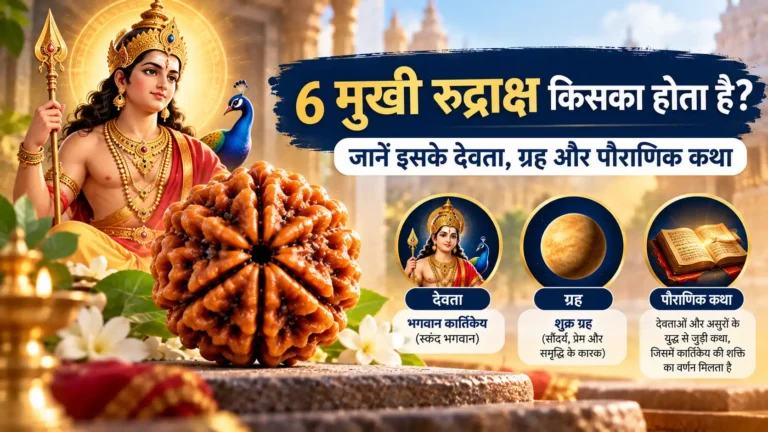
| 6 | Kartikeya (v.71) | Kartikeya and Vinayaka | Kartikeya | Venus | SP; RJU |
| 7 | Ananga (Kamadeva) (v.72) | Sapta Matrikas (seven mothers) | Mahalakshmi | Saturn | SP; RJU |
| 8 | Vasumurti and Bhairava (v.73) | Ashta Matrikas, eight Vasus, Ganga | Ganesha | Rahu | SP; RJU |
| 9 | Bhairava; Durga of nine forms (v.74) | Nine Shaktis | Durga | Ketu | SP; RJU |
| 10 | Janardana (Vishnu) (v.76) | Yama | Vishnu | None | SP; RJU |
| 11 | Rudra (v.77) | Eleven Rudras | Ekadash Rudra / Hanuman | None | SP; RJU |
| 12 | Twelve Adityas (v.78) | Vishnu and twelve Adityas | Surya | Sun | SP; RJU |
| 13 | Vishvedeva (v.79) | Kamadeva | Kamadeva / Indra | Venus | SP; RJU |
| 14 | The highest Shiva (v.80) | Linked with good health | Shiva / Hanuman | Saturn | SP; RJU |
Source: Nama Veda review of the wisdomlib Shiva Purana translation and the R.A. Sastri translation on shaivam.org, September 2026.
What this means for buyers: the planet column is a useful modern convention for astrologers, not a scriptural rule. If a seller tells you “the Puranas say 7 Mukhi is ruled by Saturn”, that claim is not in the two texts most people cite. The Shiva Purana also recommends wearing large numbers of beads, including a full set of 1,100 (verse 24), which shows how differently Rudraksha was worn in the past.
1 to 14 Mukhi Rudraksha explained
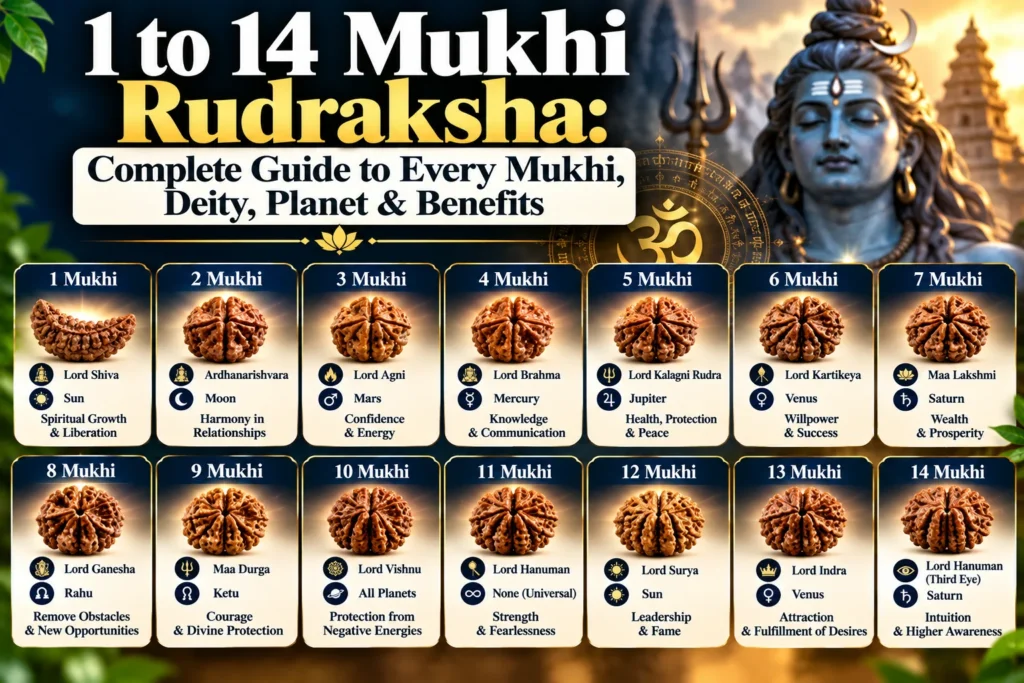
Each mukhi rudraksha is traditionally chosen for a different purpose: 1 Mukhi for spiritual focus, 5 Mukhi for daily japa, 7 Mukhi for prosperity, 8 Mukhi for new beginnings and 11 Mukhi for courage. The short notes below summarise each bead; the linked guides go deeper into benefits, mantra and wearing rules.
1 Mukhi Rudraksha
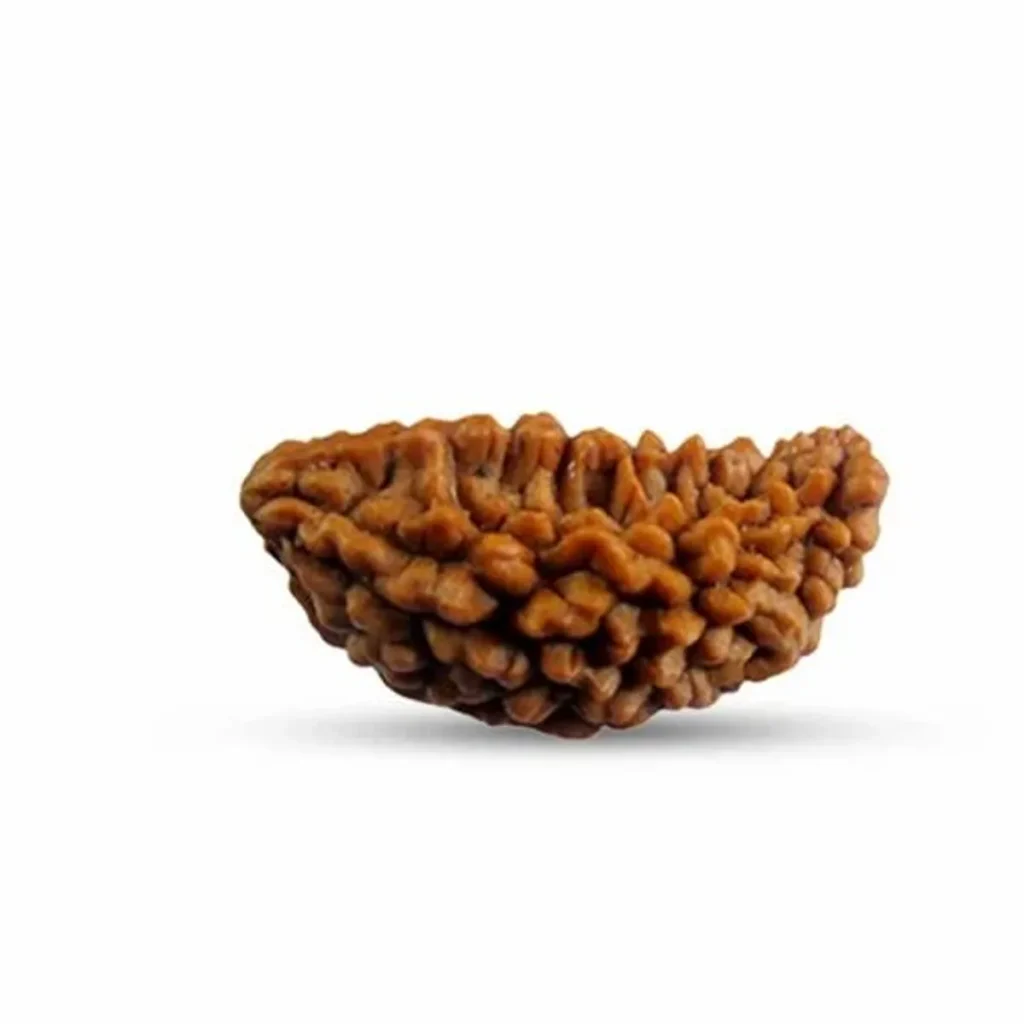
The Shiva Purana calls it “Shiva Himself” and says it gives both worldly enjoyment and liberation. It is linked with the Sun and chosen for meditation and leadership. Genuine round beads are extremely rare, so most people wear the half-moon form. Read the 1 Mukhi Rudraksha guide and why most round 1 Mukhi beads are fake.
2 Mukhi Rudraksha
Linked with Ardhanarishvara in the Upanishad and with the Moon in astrology, it is chosen for relationships and emotional balance. Traders in 2015 quoted it at NPR 20,000–30,000 at the farm gate (Kathmandu Post, 2015), far above 3 to 8 Mukhi. See 2 Mukhi Rudraksha for love and relationships.
3 Mukhi Rudraksha
Associated with the three sacred fires, it is worn for letting go of past guilt and for confidence. It is one of the more affordable Nepali beads. Read the 3 Mukhi Rudraksha guide.
4 Mukhi Rudraksha
Both texts link it with Brahma, which is why students, teachers and writers choose it. Read the 4 Mukhi Rudraksha guide.
5 Mukhi Rudraksha
The most common bead and the usual choice for a japa mala. Common five-faced seeds once sold for NPR 30 per kg before Chinese demand pushed single seeds to around NPR 2,000 (Kathmandu Post, 2015; Business Today, 2026). Read 5 Mukhi Rudraksha benefits.
6 Mukhi Rudraksha
Linked with Kartikeya and, in astrology, Venus. It is worn for willpower and focus and is a popular student bead. Read the 6 Mukhi Rudraksha guide.
7 Mukhi Rudraksha
Sold today as the Mahalakshmi bead for prosperity, although the Shiva Purana names Ananga and the Upanishad names the seven mothers. Read 7 Mukhi Rudraksha benefits and our 7 Mukhi price comparison.
8 Mukhi Rudraksha
Popularly linked with Ganesha and Rahu and chosen for new beginnings. In Bhojpur’s trade, beads with eight or more mukhis are the ones classed as “mukhi” Rudraksha rather than common seed (Ratopati, 2026). Read the 8 Mukhi Rudraksha guide.
9 Mukhi Rudraksha
Linked with Durga in her nine forms in both texts, and with Ketu in astrology. Read the 9 Mukhi Rudraksha guide.
10 Mukhi Rudraksha
The Shiva Purana calls it Janardana (Vishnu) itself. It is kept as a protective bead. Read the 10 Mukhi Rudraksha guide.
11 Mukhi Rudraksha
Linked with the eleven Rudras; the Shiva Purana says the wearer “becomes victorious everywhere”. Read the 11 Mukhi Rudraksha guide.
12 Mukhi Rudraksha
Both texts link it with the twelve Adityas (solar deities), so it is worn for leadership. Read the 12 Mukhi Rudraksha guide.
13 Mukhi Rudraksha
The Upanishad links it with Kamadeva, and it is worn for charm and creativity. Bhojpur farm-gate prices in 2025 were NPR 5,000–15,000 (Singhadarbar, 2025). Read the 13 Mukhi Rudraksha guide.
14 Mukhi Rudraksha
Called “the highest Shiva” in the Shiva Purana and traded at NPR 10,000–50,000 in Bhojpur in 2025 (grouped with 15 Mukhi) (Singhadarbar, 2025). Read the 14 Mukhi Rudraksha guide.
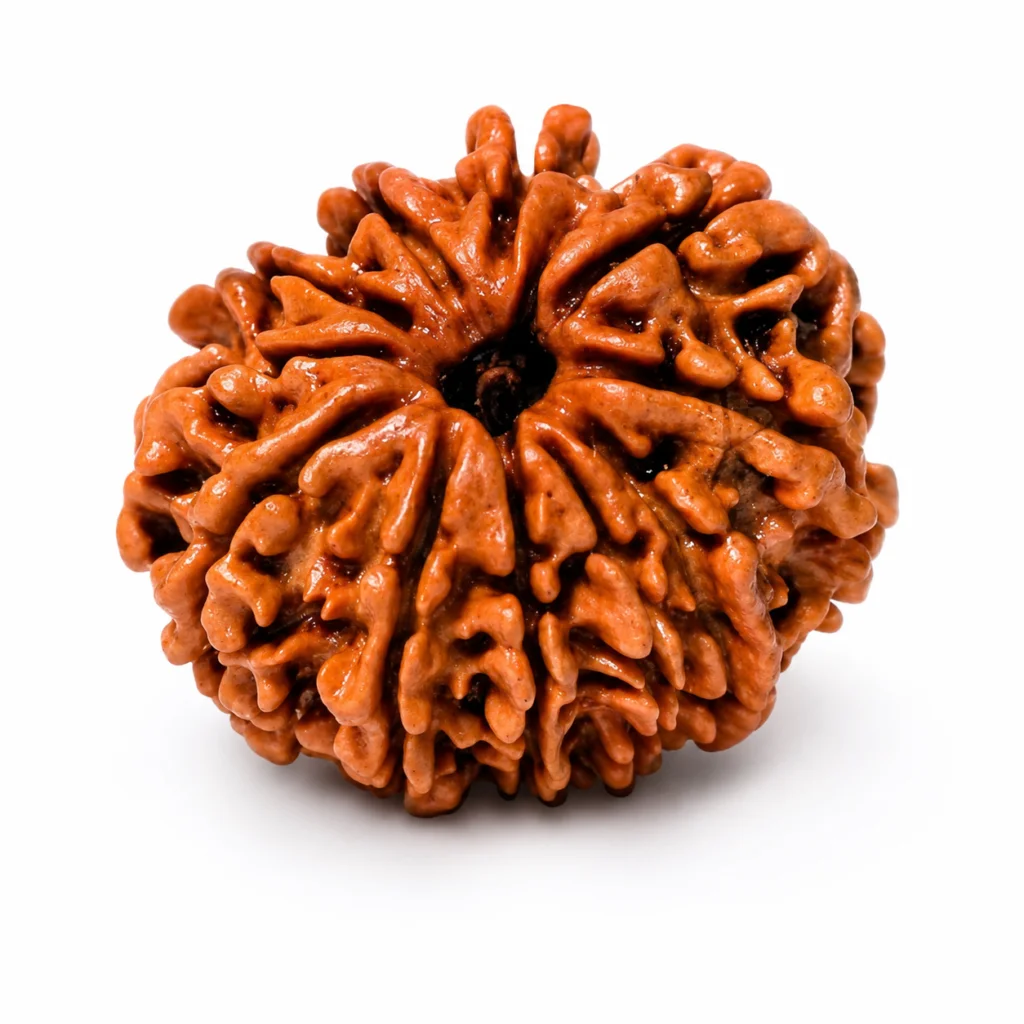
How much rudraksha does Nepal export, and at what price?
Nepal exported 684,909 kg of rudraksha worth NPR 39.1 million between mid-July 2024 and mid-February 2025, and India took 69.5% of it. That works out to about NPR 57 (₹36) per kilogram, showing that most exported volume is common, unsorted seed rather than rare mukhis.
| Period | Destination | Quantity (kg) | Declared value (NPR) | Value per kg (NPR) | Source |
|---|---|---|---|---|---|
| FY 2018/19 | China | 444,722 | 86.7 million | 195 | Dialogue Earth, 2022 (Dept. of Customs) |
| FY 2019/20 | China | 264,390 | 39.2 million | 149 | Dialogue Earth, 2022 (Dept. of Customs) |
| FY 2020/21 | China | 280,874 | 26 million | 93 | Dialogue Earth, 2022 (Dept. of Customs) |
| FY 2081/82 (mid-Jul 2024 to mid-Feb 2025) | All | 684,909 | 39,146,000 | 57 (calc.) | Global Voices, 2025 |
| FY 2081/82 (same period) | India | 475,776 | Not reported | — | Global Voices, 2025 |
| FY 2081/82 (same period) | China | 208,966 | Not reported | — | Global Voices, 2025 |
Source: Nepal Department of Customs data via Dialogue Earth, 2022. No later China-only value series was found as of September 2026.
The 2022 figures are from before 2025, and we did not find a newer China-only value series as of September 2026. The trend still matters: Chinese buyers once paid up to NPR 1–1.5 million per kilogram for select seeds at the peak, while common seed fell to around NPR 100 per kilogram (Dialogue Earth, 2022). New routes are also opening: in January 2026, a Sankhuwasabha firm sent 4,500 kg to China through the Kimathanka border crossing for the first time (Ekantipur, 2026).
What do Nepali farmers get paid per mukhi?
Bhojpur farm-gate prices in 2025 ranged from NPR 1,500–5,000 for 8 to 12 Mukhi beads to NPR 200,000–600,000 for a 21 Mukhi, according to local traders. Prices depend on mukhi count, size and shape, so the ranges below are wide and are traders’ quotes, not official data.
| Mukhi band | 2015 farm-gate price (NPR) | 2025 farm-gate price (NPR) | 2025 price in INR (calc.) | Source |
|---|---|---|---|---|
| 2 Mukhi | 20,000–30,000 | Not reported | — | Kathmandu Post, 2015 |
| 3 Mukhi | 300–500 | Not reported | — | Kathmandu Post, 2015 |
| 8 Mukhi | 1,500–3,000 | 1,500–5,000 (8–12 band) | ₹938–3,125 | KP, 2015; Singhadarbar, 2025 |
| 9–11 Mukhi | 5,000–10,000 | 1,500–5,000 (8–12 band) | ₹938–3,125 | KP, 2015; Singhadarbar, 2025 |
| 13 Mukhi | Not reported | 5,000–15,000 | ₹3,125–9,375 | Singhadarbar, 2025 |
| 14–15 Mukhi | Not reported | 10,000–50,000 | ₹6,250–31,250 | Singhadarbar, 2025 |
| 16 Mukhi | Not reported | 50,000–100,000 | ₹31,250–62,500 | Singhadarbar, 2025 |
| 21 Mukhi | Not reported | 200,000–600,000 | ₹1.25–3.75 lakh | Singhadarbar, 2025 |
Source: Manoj Chapagain, quoted by Ratopati, March 2026.
The 9 to 11 Mukhi quote fell from NPR 5,000–10,000 in 2015 to within NPR 1,500–5,000 in 2025, but the two reports group mukhis differently, so the drop should be read as indicative, not exact. Growers face a long wait: rudraksha trees usually take around seven years to bear fruit, and one farmer told Business Today that some growers inject plant growth regulators up to four times (Business Today, 2026). INR values use the Nepal Rastra Bank peg of ₹100 = NPR 160 (NRB).
What does a certified mukhi bead cost in India in 2026?
At Nama Veda, a lab-certified Nepali mukhi rudraksha ranges from ₹499 for a 5 Mukhi to ₹6,999 for a 12 Mukhi as of 30 September 2026, a 14x spread. Price does not rise in a straight line with mukhi count; supply of each mukhi, bead size and certification drive the cost.
| Bead | Price (30 Sep 2026) | Multiple of 5 Mukhi price | Source |
|---|---|---|---|
| 1 Mukhi | ₹4,999 | 10.0x | Nama Veda product page |
| 2 Mukhi | ₹3,999 | 8.0x | Nama Veda product page |
| 3 Mukhi | ₹751 | 1.5x | Nama Veda product page |
| 4 Mukhi | ₹699 | 1.4x | Nama Veda product page |
| 5 Mukhi | ₹499 | 1.0x | Nama Veda product page |
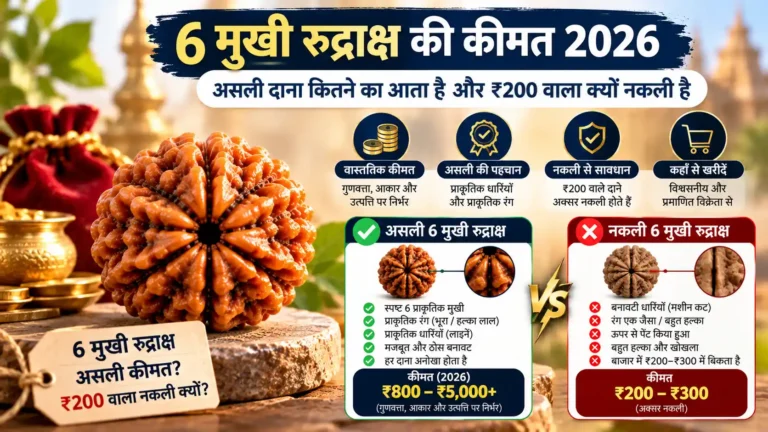
| 6 Mukhi | ₹899 | 1.8x | Nama Veda product page |
| 7 Mukhi | ₹749 | 1.5x | Nama Veda product page |
| 8 Mukhi | ₹4,999 | 10.0x | Nama Veda product page |
| 9 Mukhi | ₹3,499 | 7.0x | Nama Veda product page |
| 10 Mukhi | ₹4,499 | 9.0x | Nama Veda product page |
| 11 Mukhi | ₹5,999 | 12.0x | Nama Veda product page |
| 12 Mukhi | ₹6,999 | 14.0x | Nama Veda product page |
| 13 Mukhi (pendant) | ₹5,449 | 10.9x | Nama Veda product page |
Source: Nama Veda calculation from Global Voices (2025) customs figures and the Nama Veda catalogue, September 2026.
Two patterns stand out. First, 3 to 7 Mukhi beads stay close to the 5 Mukhi price because they are common. Second, 2 Mukhi and 8 Mukhi are priced near the 10 to 12 Mukhi range, which matches the 2015 farm-gate quotes where 2 Mukhi fetched more than 8 Mukhi. The gap between the customs value of bulk seed and a retail bead reflects sorting, sizing, lab testing and the rarity of individual mukhis. Read more in why some Rudraksha beads are so expensive and our Rudraksha buying guide.
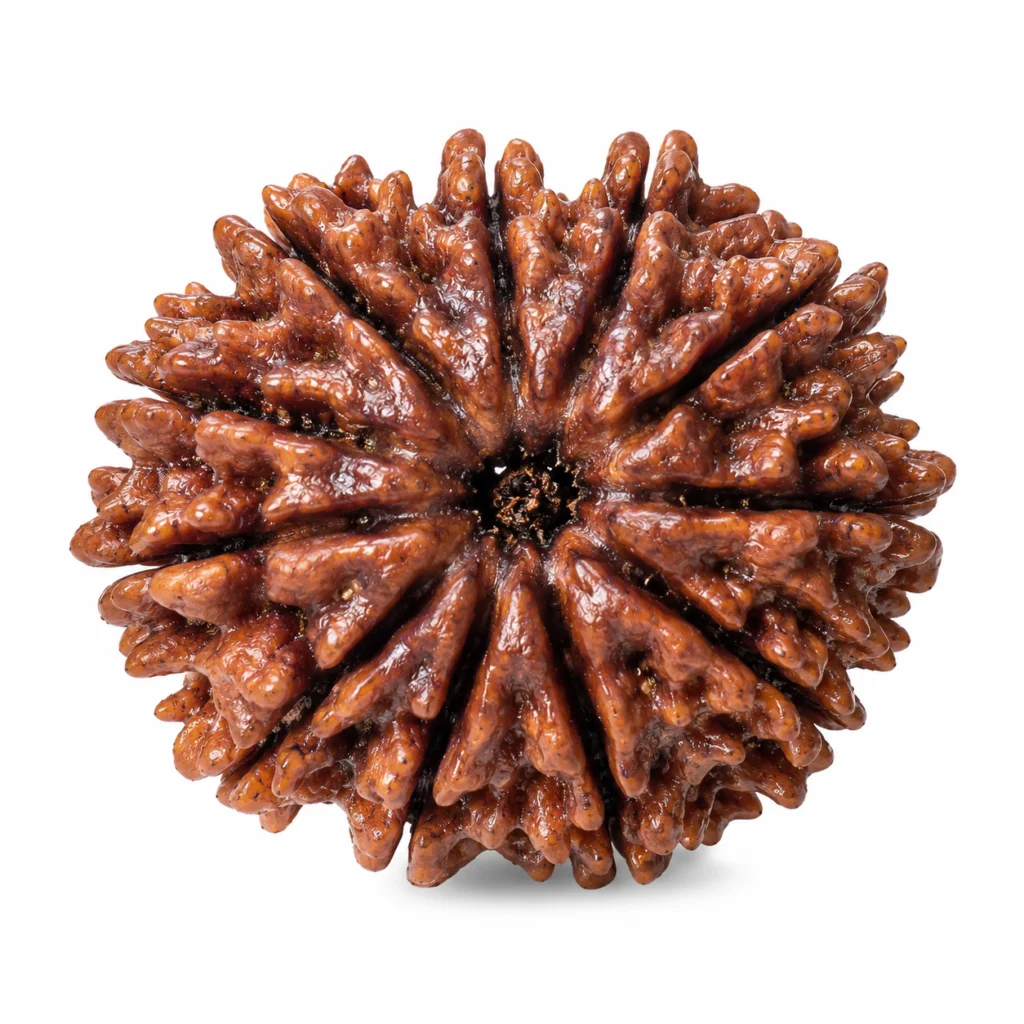
Which rudraksha figures contradict each other?
Published figures on Nepal’s rudraksha trade disagree by up to 5x on value and by more than 3x on volume. Most numbers come from local officials and trader associations rather than audited data, so we show the conflicts instead of picking one.
| Claim | Figure A | Figure B | Sources |
|---|---|---|---|
| Bhojpur’s annual rudraksha trade | NPR 150–200 million (Feb 2025) | About NPR 1 billion (Jan and Mar 2026) | Singhadarbar; Khabarhub; Ratopati |
| Volume sold / exported | About 2.1 million kg sold “last year” (Mar 2026) | 684,909 kg exported in 7 months of FY 2081/82 | Ratopati; Global Voices |
| Volume to China | About 600,000 kg (Mar 2026) | 208,966 kg in 7 months of FY 2081/82 | Ratopati; Global Voices |
| Price of a 21 Mukhi bead | NPR 200,000–600,000 (price table) | NPR 20–60 lakh (same article); NPR 5.5–6 million (2026); one sold for NPR 7.4 million (2026) | Singhadarbar; Ratopati; Khabarhub |
| Highest mukhi found in Nepal | Up to 23 mukhi | 29 mukhi found in Dingla | Global Voices; Ratopati |
| Altitude where the tree grows | Up to 1,400 m in Bhojpur | Recorded at 1,625 m in Nepal | Singhadarbar; eFlora of India |
Some differences are explained by scope: “sold” can include domestic sales, and a full year is larger than seven months. Others, such as the 21 Mukhi price range within a single article, look like reporting errors. Until Nepal publishes audited, mukhi-wise trade data, treat any single figure with caution.
Interactive: Mukhi Rudraksha explorer
Use this tool to see, for any mukhi from 1 to 14, what the two main texts say, what astrology adds and what the bead costs. It pulls from the same sources as the tables above, so you can check a seller’s claims in a few seconds.
Farm-gate: Bhojpur traders via Kathmandu Post (2015) / Singhadarbar (2025). Retail: Nama Veda catalogue, 30 Sep 2026. Mantra: commonly published beej mantra.
How to choose and wear the right mukhi
Start with your intention, then check the bead. For daily japa and a calm mind, choose 5 Mukhi. For study and speech, 4 or 6 Mukhi. For career, 7 or 12 Mukhi. For relationships, 2 Mukhi. For new beginnings, 8 Mukhi. For courage and protection, 9, 10 or 11 Mukhi.
If you follow astrology, match the bead with your chart using our guide on which Rudraksha suits your birth chart or Rudraksha for zodiac signs. Students can compare 5 Mukhi vs 6 Mukhi, and people focused on work can read the best Rudraksha for career growth.
Most families energise a new bead on a Monday morning: wash it with clean water or Gangajal, offer a flower and chant the mukhi’s mantra or “Om Namah Shivaya” 108 times. Wear it in a red or black thread or in metal; our guide on wearing Rudraksha with gold or silver covers the options. Women can wear Rudraksha too; see common questions answered.
Before buying, check the grooves, ask for an X-ray lab report and compare origin. Our guides on how to identify original Rudraksha and Nepali vs Indonesian Rudraksha walk through each check.
Methodology
This guide was compiled between 28 and 30 September 2026. We searched English-language Nepali and Indian news, scripture translations, botanical databases and trade reporting for published rudraksha figures from 2015 to 2026.
- Sources consulted: 18 web sources, including news reports, two scripture translations, a botanical database, the Nepal Rastra Bank exchange-rate page and several retailer catalogues.
- Sources cited: 14 sources across 14 domains, listed below. Retailer marketing pages and unsourced blogs were consulted but not cited.
- Calculations: export shares and per-kg values were calculated from the raw totals reported. INR conversions use the Nepal Rastra Bank peg of ₹100 = NPR 160.
- Scripture comparison: based on the wisdomlib English translation of the Shiva Purana and the R.A. Sastri translation of the Rudraksha Jabala Upanishad. Other translations and recensions may differ.
- Limitations: we could not access the Nepal Department of Customs database directly, so trade figures rely on journalists who reported it. Farm-gate prices are traders’ quotes. Retail prices are Nama Veda’s own and are not a market survey. Figures before 2025 are marked with their year.
- Update cadence: we plan to review this page every six months, or sooner when Nepal publishes new customs data.
Frequently asked questions
Which mukhi rudraksha is best for beginners?
Most people start with a 5 Mukhi Rudraksha because it is common, affordable and traditionally suitable for everyone. At Nama Veda, a certified 5 Mukhi Nepali bead costs ₹499 as of September 2026, the lowest single-bead price in our mukhi range. It is also the standard bead used in a 108-bead japa mala.
Does the Shiva Purana say which planet rules each mukhi?
No. In the Shiva Purana (Vidyeshvara Samhita, chapter 25), verses 64 to 80 describe the deity and benefit of 1 to 14 Mukhi beads, but none of the 14 entries names a planet. The same is true of the Rudraksha Jabala Upanishad. Planetary rulers such as Saturn for 7 Mukhi come from later astrological practice.
Why is a 1 Mukhi or 14 Mukhi rudraksha so expensive?
Higher and rarer mukhis grow far less often. Bhojpur traders quoted 14 to 15 Mukhi beads at NPR 10,000–50,000 at the farm gate in 2025, compared with NPR 1,500–5,000 for 8 to 12 Mukhi, according to Singhadarbar. Genuine round 1 Mukhi beads are rarer still, which is why fakes are common.
Where does most Nepali rudraksha go?
India is now the biggest buyer. In the first seven months of Nepal’s FY 2081/82 (mid-July 2024 to mid-February 2025), 475,776 kg of the 684,909 kg exported went to India, or 69.5%, and 208,966 kg went to China, based on Department of Customs figures reported by Global Voices.
How can I tell if a mukhi rudraksha is original?
Count the natural grooves, check that none are carved or filled, and ask for an X-ray lab report showing the same number of internal chambers. Be wary of rare beads at very low prices: in 2025, Bhojpur traders priced even 13 Mukhi beads at NPR 5,000–15,000 (about ₹3,125–9,375) at the farm gate, before sorting and certification.
Can I wear more than one mukhi together?
Yes. Combinations are common, and the Shiva Purana itself describes wearing large sets, including 1,100 beads in verse 24. Today most people wear two or three beads chosen for their intention, such as 5 and 7 Mukhi together. If you are unsure, start with one bead and add others later.
Sources and references
- Global Voices, “The story of Nepal’s enigmatic rudraksha seeds through photos”, 17 March 2025
- Dialogue Earth, “How a seed encapsulates Nepal–China trade imbalance”, 26 May 2022 (Department of Customs data)
- Scroll.in, “Why the rudraksha seed is a symbol of Nepal’s trade imbalance with China”, 28 May 2022
- Singhadarbar, “Rudraksha becoming a source of income for Bhojpur farmers”, 17 February 2025
- Ratopati, “Rudraksha cultivation becomes major income source for farmers in Bhojpur”, 18 March 2026
- Khabarhub, “Bhojpur emerges as Nepal’s hub for commercial Rudraksha farming”, 10 January 2026
- Business Today, “From cosmic to cosmetic: rudraksha trade”, 20 June 2026
- Ekantipur (Kantipur), “Rudraksha from Sankhuwasabha reaches China for the first time through Kimathanka”, 22 January 2026
- The Kathmandu Post, “Rudraksha seeds bring good returns to farmers”, 22 July 2015
- Shiva Purana, Vidyeshvara Samhita, chapter 25 “The greatness of Rudraksha” (English translation, wisdomlib)
- Rudraksha Jabala Upanishad, English translation by R.A. Sastri (shaivam.org)
- eFlora of India, “Elaeocarpus angustifolius”
- Nepal Rastra Bank, foreign exchange rates (INR peg)
- Nama Veda product catalogue, Rudraksha prices checked 30 September 2026
Last updated: · Reviewed by the Nama Veda Editorial Team. This article shares traditional beliefs and published data for general information. Rudraksha is not a substitute for medical, financial or professional advice.