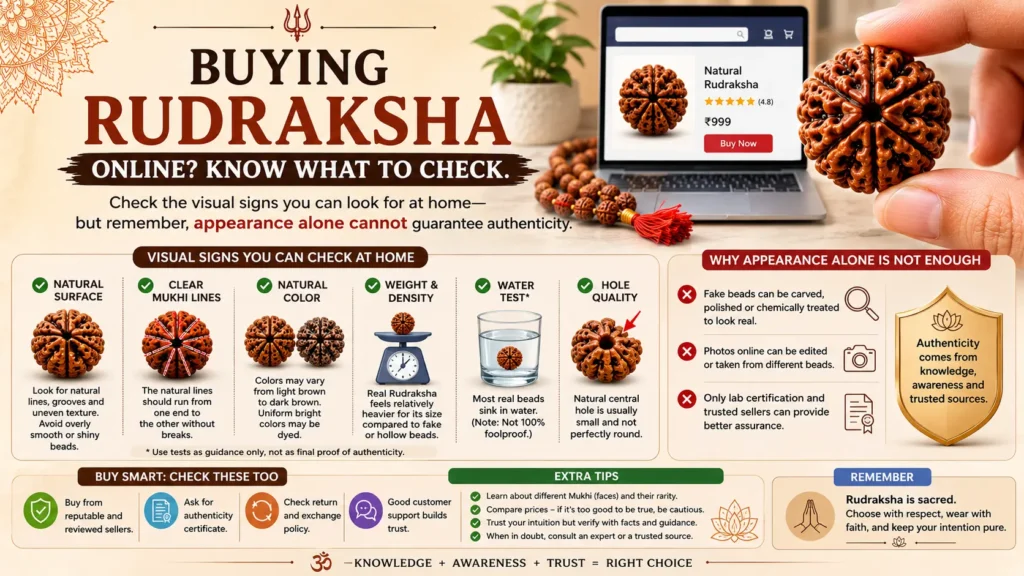
Buying an original Rudraksha can be difficult when you’re relying only on product photos. Some artificial or altered beads can look convincing at first glance.
Shop: Govt lab-certified Nepali Rudraksha beads
The checks below help you spot red flags before you buy. Remember that visual inspection alone cannot conclusively prove authenticity; for expensive or rare beads, credible lab testing and a trustworthy seller matter most.
Quick checklist
- Mukhi lines look natural and run from one end of the bead to the other
- Surface is textured, not over-polished or artificially smooth
- Size is given in millimetres, not just “large” or “premium”
- Real photos of the actual bead from several angles
- A certificate from an identifiable lab that matches your bead (for expensive beads)
- Clear product details, invoice and a usable return policy
- No guaranteed promises of health, wealth or success
1. Count and inspect the Mukhi lines
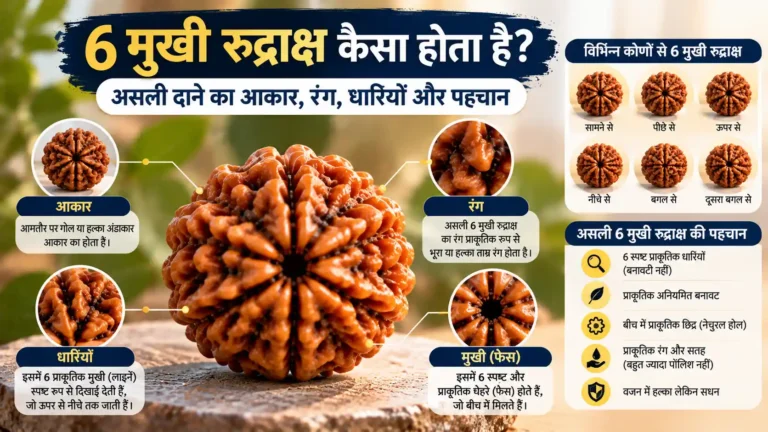
Mukhi lines are the natural grooves running from one end of the Rudraksha to the other. Count them carefully and check whether they look naturally formed rather than artificially carved.
When buying online, look closely at the lines in the product photographs. Be cautious of unclear images or beads where the lines look carved.
2. Examine the surface and shape
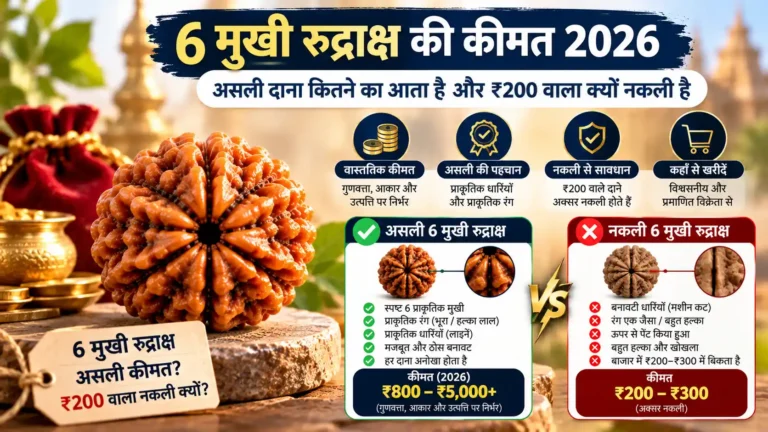
Natural Rudraksha typically has a distinctive, textured surface. A bead that looks excessively polished, artificially smooth or unusually uniform deserves closer examination.
Beads aren’t perfectly identical: differences in size, shape and texture are normal. An extremely uniform look across several supposedly natural beads may be worth questioning, but appearance alone shouldn’t be the final verdict.
3. Check the size in millimetres
Rudraksha beads come in different sizes, and a bigger bead doesn’t automatically mean better quality. Ask the seller for the actual bead diameter in millimetres rather than relying on words like “large” or “premium.”
4. Don’t rely on water or coin tests
You’ll find many online “water tests,” “copper coin tests” and other home methods. These should not be treated as proof of authenticity. For valuable Rudraksha, professional examination is a much better approach.
5. Check the certificate properly
For rare or high-value Rudraksha, a credible authentication report adds confidence. But the word “certified” alone isn’t enough. A useful report should show:
- Rudraksha type or Mukhi count
- Identification details of the bead
- Testing information
- The issuing laboratory or organisation
- A report number or date
For an individual high-value bead, the report should be clearly linked to that specific bead. Check who issued it: a certificate from an identifiable testing organisation is worth far more than an attractive document created for marketing. If unsure, verify the organisation and report details.
A certificate may authenticate certain characteristics, but it does not guarantee seller claims about spiritual benefits, planetary effects, guaranteed results or investment value. Certification matters most for rare Mukhi beads, expensive or collector pieces, and beads that are hard to judge visually. For ordinary low-cost Rudraksha, seller reputation and product quality matter more.
6. Check the seller and the listing
Avoid relying on generic catalogue images. For individual or high-value Rudraksha, look for clear photos of the actual bead from multiple angles. If the seller claims an origin, such as Nepali or Indonesian, check that it is documented; don’t judge origin by appearance alone.
A reliable seller should clearly state:
- Rudraksha type and Mukhi
- Approximate size
- Origin, if claimed
- Bead condition
- Mounting or threading details
- Contact information and a return or replacement policy
After you order, the bead should match the listing. Good packaging protects it from impact and moisture, basic care instructions help first-time buyers, and you should keep the invoice in case anything doesn’t match the description.
7. Be careful with guaranteed claims
Be cautious when sellers promise guaranteed results such as wealth, health improvement or instant success. Rudraksha has important traditional and spiritual significance, but such outcomes are not scientifically guaranteed.
Red flags to watch for
- Refuses to give basic product details
- Uses only generic images
- Makes guaranteed spiritual claims
- Provides certificates you can’t verify
- Very cheap prices for supposedly rare beads
- No clear return policy
If several of these apply, consider another seller.
Read in Hindi
- असली रुद्राक्ष की पहचान कैसे करें
- 1 मुखी रुद्राक्ष असली vs नकली
- Why most round 1 Mukhi Rudraksha are fake
Final takeaway
You can check Mukhi lines, texture, shape and size at home, but none of these visual checks can guarantee that a Rudraksha is genuine. For expensive beads, rely on credible authentication, real photos, an invoice, secure packaging and a clear return policy rather than viral home tests.
FAQs
How can I identify an original Rudraksha at home?
You can inspect its Mukhi lines, surface and shape, but home inspection cannot conclusively prove authenticity.
Does a water test prove Rudraksha is original?
No. Common home tests such as water or copper coin tests should not be considered definitive authentication methods.
Do original Rudraksha beads have a rough surface?
Natural Rudraksha commonly has a textured surface, but appearance varies between individual beads.
How do I count Rudraksha Mukhi lines?
Look for the natural grooves running from one end of the bead to the other and count the distinct sections.
Does a bigger Rudraksha mean it is better?
No. Size alone doesn’t determine authenticity or quality.
Is certification necessary for every Rudraksha?
Not always, but credible certification is especially useful for rare or expensive beads.
How do I know if a Rudraksha certificate is genuine?
Check the issuing organisation, the report details and whether the certificate can be independently verified and matched to your bead.
Can a certificate guarantee Rudraksha benefits?
No. Certification and spiritual benefit claims are separate matters.
Can photos prove Rudraksha authenticity?
No. Photos help with visual inspection but cannot conclusively establish authenticity.
Should I buy a very cheap Rudraksha?
Don’t use price alone to judge authenticity. Extremely low prices for supposedly rare beads should prompt additional verification.
What if the Rudraksha I receive doesn’t match the listing?
Check the seller’s return or replacement policy and contact them promptly with photographs and purchase details.