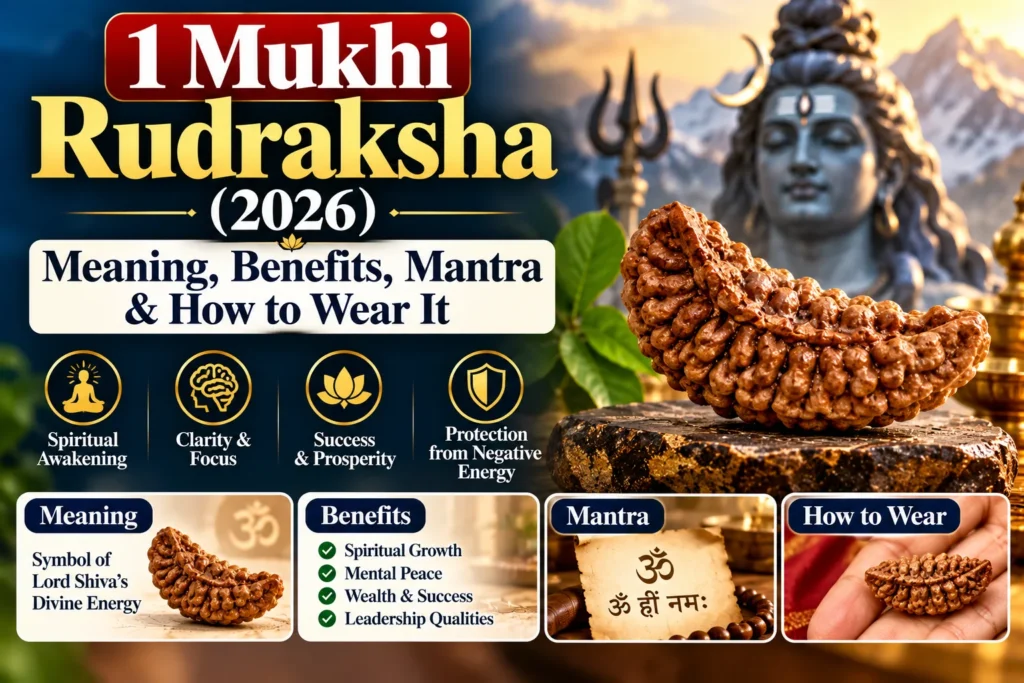
- Scripture: the Shiva Purana (ch. 25, v.64) describes the 1 Mukhi Rudraksha as “Shiva Himself”, giving worldly enjoyment and liberation (wisdomlib translation).
- Upanishad: the Rudraksha Jabala Upanishad links it with the Supreme Reality (shaivam.org).
- Planet: Sun, a later astrological association not found in either text.
- Retail price: a certified 1 Mukhi Rudraksha costs ₹4,999 at Nama Veda as of 30 September 2026.
Table of Contents
The 1 Mukhi Rudraksha is often called the king of all Rudraksha beads. It has a single natural line and is considered a direct symbol of Lord Shiva. Because of its rarity and meaning, it is also one of the most faked beads in the market.
Here is what the 1 Mukhi Rudraksha represents, who traditionally wears it and what to check before you buy one.
What is a 1 Mukhi Rudraksha?
A 1 Mukhi (Ek Mukhi) Rudraksha has one natural line running across its surface. It comes in two main forms:
- Round 1 Mukhi (Nepali): Extremely rare. Most “round Ek Mukhi” beads sold cheaply online are not genuine. Read why 90% of round 1 Mukhi Rudrakshas are fake.
- Half-moon or Kaju 1 Mukhi: Shaped like a cashew and found mainly in South India and Sri Lanka. This is the form most people actually wear.
Deity, planet and mantra
| Detail | 1 Mukhi Rudraksha |
|---|---|
| Ruling deity | Lord Shiva |
| Ruling planet | Sun (Surya) |
| Beej mantra | Om Hreem Namah |
| Best day to start wearing | Monday |
Traditional benefits of 1 Mukhi Rudraksha
In tradition, the 1 Mukhi is linked with higher consciousness and detachment. People commonly wear it for:
- Spiritual focus: Many meditators and sadhaks keep it during japa and meditation.
- Leadership and self-confidence: Because of its link with the Sun, it is associated with authority, clarity and a strong sense of self.
- Concentration: Some people believe it helps them stay focused on long-term goals.
- Sun-related remedies: In Vedic astrology, it is sometimes suggested when the Sun is weak in a birth chart.
These are traditional beliefs, and experiences differ from person to person.
Who usually wears a 1 Mukhi Rudraksha?
- People on a serious spiritual path or daily meditation practice
- Business owners, managers and people in leadership roles
- Those advised by an astrologer to strengthen the Sun
Because it is linked with detachment, some families suggest that people who are newly married or deeply focused on material life start with a 5 Mukhi instead. This is a guideline, not a rule.
How to wear a 1 Mukhi Rudraksha
- Choose a Monday morning after bathing.
- Wash the bead with clean water or Gangajal and place it in front of a Shiva image.
- Offer a flower and incense, then chant “Om Hreem Namah” or “Om Namah Shivaya” 108 times.
- Wear it in a red or black silk thread, or cap it in silver or gold, as a pendant close to the heart.
- Many people also keep a 1 Mukhi in their puja room instead of wearing it daily.
How to identify an original 1 Mukhi Rudraksha
- Check the line: It must be natural and unbroken, not carved or filled.
- Ask for a lab certificate: An X-ray or CT scan report from a recognised lab can show internal seed chambers that match the number of mukhis.
- Be careful with price: A genuine round Nepali 1 Mukhi can cost a very large amount. A “round Ek Mukhi” for a few hundred rupees is almost never real.
- Avoid the water test myth: Floating or sinking does not prove anything. Read how to identify original Rudraksha for reliable checks.
1 Mukhi Rudraksha price
The price depends on shape (round or Kaju), origin, size and certification. Kaju beads are more affordable, while round Nepali beads are collector items. Read our detailed 1 Mukhi Rudraksha price guide.
What do the scriptures say about the 1 Mukhi Rudraksha?
The Shiva Purana (Vidyeshvara Samhita, chapter 25, verse 64) describes the 1 Mukhi Rudraksha as Shiva Himself, giving worldly enjoyment and liberation. The Rudraksha Jabala Upanishad links it with the Supreme Reality. Neither text names a ruling planet; the link with Sun comes from later astrology.
You can read both passages in English in the Shiva Purana translation on wisdomlib and the Rudraksha Jabala Upanishad on shaivam.org. Botanically, every mukhi is the stone of the same tree, Elaeocarpus angustifolius (often sold as E. ganitrus), as listed in the eFlora of India. To see how this bead compares with its neighbours, read the 2 Mukhi Rudraksha guides, or compare all fourteen side by side in our mukhi rudraksha guide.
Frequently asked questions
Can anyone wear a 1 Mukhi Rudraksha?
Most traditions allow anyone to wear it with respect. Some people prefer to consult an astrologer first because of its strong association with the Sun and detachment.
Can I wear 1 Mukhi with other Rudraksha?
Yes. It is often combined with 5 Mukhi beads in a mala or bracelet.
Is Kaju 1 Mukhi real?
Yes. The half-moon (Kaju) bead is a genuine 1 Mukhi variety, and it is the most commonly available form.
Buy a certified 1 Mukhi Rudraksha
Explore our 1 Mukhi Nepali Rudraksha (Govt Lab Certified). Want to compare with other beads? Read our complete 1 to 14 Mukhi Rudraksha guide.
Disclaimer: This article shares traditional and spiritual beliefs for general information. Rudraksha is not a substitute for medical, financial or professional advice.
Sources and references
- Shiva Purana, Vidyeshvara Samhita, ch. 25 (wisdomlib)
- Rudraksha Jabala Upanishad, tr. R.A. Sastri (shaivam.org)
- eFlora of India: Elaeocarpus angustifolius
- Nama Veda: 1 to 14 Mukhi Rudraksha guide and data, 2026
Last updated: · Nama Veda Editorial Team