

For years, Indians have picked holiday destinations based on budgets, leave dates, weather, or the perfect Instagram view.
But what if your birth chart could have a say in where you travel next?
A growing number of travellers are turning to astrologers before planning a trip, with a recent lifestyle report suggesting that around 22 per cent of Indian travellers have timed a trip after consulting an astrologer.
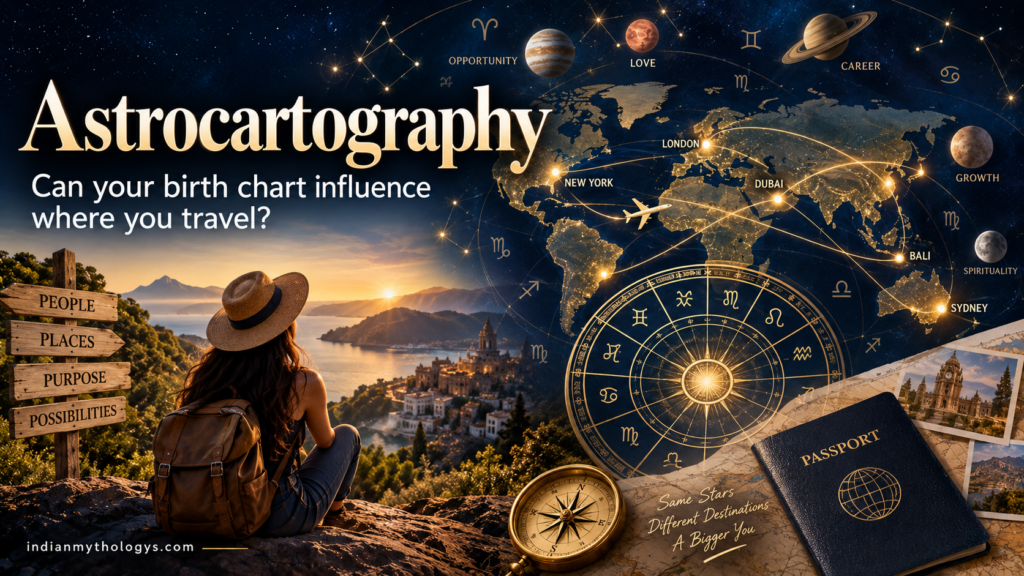
This has brought a fascinating concept into the spotlight: astrocartography — the practice of using your birth chart to explore which places around the world may align with different planetary influences.
For some, it is simply another way to choose a destination. For others, it is a completely new way of looking at travel.
What is astrocartography?
Astrocartography takes your birth chart and projects it onto a world map. Different planetary lines run across different countries and cities. Each line is traditionally linked to a different theme — career, relationships, creativity, or emotional ease.
The idea is simple: some places may feel more supportive for certain areas of life according to the chart.
It is not the same as checking a muhurat for the day of travel. Muhurat looks at the timing of departure. Astrocartography looks at the location itself.
Why it is catching attention now
Three reasons stand out:
- Travel has become more personal. People want trips that feel meaningful, not just photogenic.
- Astrology has become more accessible through apps and online readings.
- After years of planned and cancelled trips, many travellers are open to new ways of deciding where to go.
The 22 per cent figure does not prove the method works. It only shows that a noticeable number of people are already using it as one input among others.
What the traditional view says
In classical astrology, place of birth is already important because it decides the lagna. Extending that logic to other places on Earth is a newer development. Older texts focused more on the chart itself and on muhurats than on world maps.
Modern astrocartography is therefore a contemporary tool built on traditional principles. It should be treated as an additional layer of interpretation, not as a fixed rule.
A balanced way to use it
If you are curious, the practical approach looks like this:
Astrocartography starts from the planets in your birth chart; if you created that chart with an app, read what an AI Kundali actually means. Where you live matters in numerology too — see house number numerology.
- Get an accurate birth chart first (date, exact time, place).
- Look at the planetary lines only as suggestions, not commands.
- Still check the usual things — budget, weather, visa, and personal interest.
- Treat the final decision as yours.
Some people notice that certain cities feel unusually comfortable or unusually challenging when they visit. Others feel no difference. Both experiences are valid.
How this connects with numbers and planets
People who already work with their Mulank and Bhagyank sometimes combine both systems. A person with a strong number 6, for example, may pay extra attention to Venus lines on the map. Those tracking current planetary movements may also consider how a place interacts with ongoing gochars such as the present Shani period or the coming Venus retrograde.
None of these layers replace common sense. They only add another way of looking at the same decision.
Final thought
Astrocartography is interesting because it sits at the meeting point of two things Indians already care about deeply — travel and the birth chart. It does not need to be believed completely to be useful as a reflective tool.
If a place keeps appearing in your chart and also feels right for practical reasons, that combination is worth noticing. If the chart says one thing and your real life says another, real life should win.
The map can offer a suggestion. You still choose the destination.
Curious about your own numbers before looking at any map? Start with a simple Mulank calculation or explore how name numerology works in the traditional system.
FAQ
What is astrocartography?
Astrocartography is a modern astrological technique that projects a person’s birth chart onto a world map to identify planetary lines associated with different themes such as career, relationships, creativity, and emotional experiences.
How does astrocartography work?
It uses your date, exact birth time, and place of birth to create a birth chart and map planetary positions across different locations around the world.
Is astrocartography the same as a travel muhurat?
No. A travel muhurat focuses on choosing an auspicious time for travel, while astrocartography focuses on how different geographical locations are interpreted through your birth chart.
Can astrocartography tell me where I should travel?
It can be used as a reflective guide for exploring destinations, but it should not be treated as a fixed instruction. Practical factors such as budget, weather, visa requirements, and personal preferences still matter.
Do planetary lines affect everyone in the same way?
Traditional interpretations vary from person to person because planetary lines are read in relation to the individual’s complete birth chart.
Can astrocartography be combined with numerology?
Some practitioners combine astrocartography with numerology, Mulank, Bhagyank, or other traditional systems. These approaches are interpretive rather than scientifically established methods.
Is astrocartography scientifically proven?
Astrocartography is an astrological practice and does not have established scientific evidence showing that planetary lines determine how a person experiences a particular location.