
Your home is not only a physical space—it is where you relax, work, spend time with family and create everyday experiences. This is why many people are interested in traditional practices that focus on creating a balanced and harmonious environment.
Feng Shui is a traditional Chinese practice concerned with the relationship between people and their surroundings. It includes ideas about space, direction, elements, arrangement and the flow of qi.
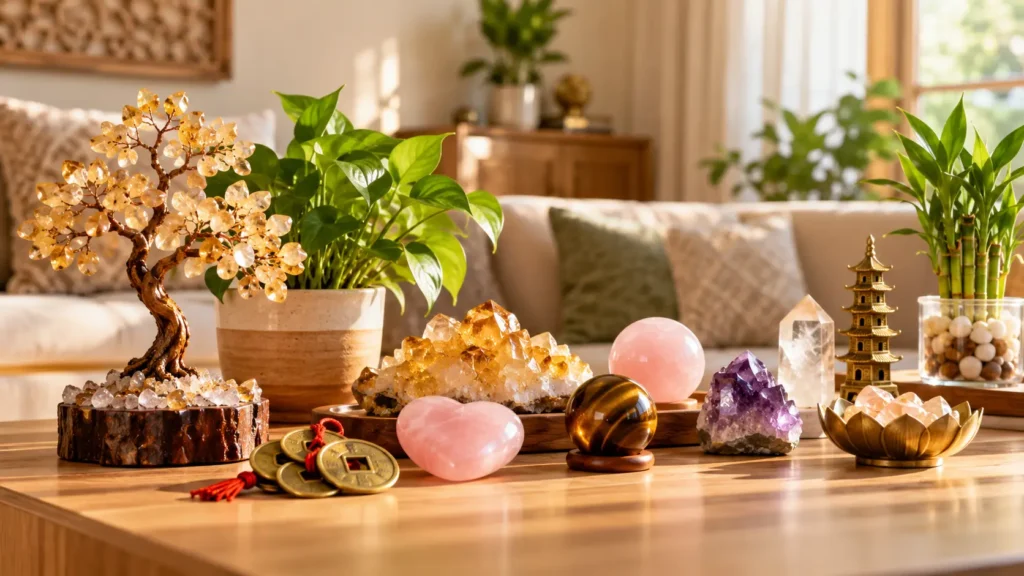
Today, Feng Shui-inspired home decor has become popular around the world. Crystal trees, natural stones, plants, decorative objects and symbolic prosperity items are often incorporated into homes as both decorative pieces and objects of personal meaning.
If you are wondering which Feng Shui items are suitable for home and where to place them, this guide covers 10 popular options and the traditional symbolism associated with them.
Table of Contents
Note: Feng Shui and crystal meanings are based on traditional, cultural or spiritual beliefs. They should not be understood as scientifically proven methods for attracting wealth, health or specific outcomes.
What Are Feng Shui Items?
Feng Shui items are objects traditionally or popularly used to complement Feng Shui-inspired spaces.
Their purpose can vary depending on the Feng Shui school, the individual’s intention and the room where the object is placed.
Common examples include:
- Crystal trees
- Natural crystals
- Plants
- Decorative coins
- Wind chimes
- Mirrors
- Water-inspired decor
- Metal objects
- Prosperity symbols
- Traditional spiritual objects
Some objects are specifically associated with particular Feng Shui concepts, while others are modern interpretations used to create a balanced and aesthetically pleasing environment.
The most important thing is not simply collecting many objects. Their placement, purpose and relationship with the overall space matter.
10 Popular Feng Shui Items for Home
1. Crystal Tree
A crystal tree is one of the most popular Feng Shui-inspired decorative pieces.
It usually consists of a miniature tree structure with branches decorated with polished gemstone chips. Different stones can be selected according to their traditional meanings.
Crystal trees are commonly associated with ideas such as:
- Growth
- Prosperity
- Balance
- Positive intentions
- Abundance
Where can you place a crystal tree?
A crystal tree can work well on:
- A living room console
- A bookshelf
- A home office shelf
- A meditation area
- A suitable prosperity corner
For a prosperity-themed arrangement, some Feng Shui practitioners associate the wealth area with the far-left section of a room when viewed from its entrance, depending on the Bagua method being followed.
A crystal tree should also complement your interior rather than make the space look crowded.
2. Citrine Crystal
Citrine is a golden-yellow variety of quartz that is particularly popular in modern crystal and prosperity practices.
It is traditionally associated with:
- Abundance
- Prosperity
- Optimism
- Confidence
- Personal motivation
Because of its warm golden colour, Citrine can also work naturally with wooden furniture and neutral interiors.
Where should you place Citrine?
Depending on the tradition you follow, Citrine may be displayed in:
- A home office
- A living room
- A prosperity area
- A personal meditation space
A Citrine Healing Crystal Bracelet can also be chosen as wearable crystal jewellery for people who prefer carrying the stone with them rather than displaying it at home.
3. Rose Quartz
Rose Quartz is a soft pink crystal commonly associated with love, compassion and emotional warmth in modern crystal traditions.
It is particularly popular for bedrooms and personal spaces.
Where can you place Rose Quartz?
Consider placing it on:
- A bedside table
- Bedroom shelf
- Dressing table
- Meditation corner
- Personal altar or spiritual space
Its soft colour can also complement minimalist and pastel interiors.
Rather than treating Rose Quartz as a guaranteed relationship remedy, it can be viewed as a symbolic reminder of love, kindness and emotional connection.
4. Tiger Eye
Tiger Eye is recognised for its distinctive golden-brown appearance and chatoyant banding.
In contemporary crystal traditions, it is often associated with:
- Courage
- Confidence
- Focus
- Grounding
- Personal strength
A Tiger Eye pendant or decorative stone can be incorporated into a personal spiritual practice or home decor arrangement.
Where can you use Tiger Eye?
Popular choices include:
- Home office
- Study area
- Personal meditation space
- Display shelf
- Personal jewellery collection
A Tiger Eye Crystal Round Pendant can be especially suitable for someone who prefers symbolic crystal jewellery over home decoration.
5. Indoor Plants
Plants are not exclusive to Feng Shui, but natural greenery has an important place in many Feng Shui-inspired interiors.
Plants can introduce a visual representation of the wood element and make a room feel more connected to nature.
Suitable locations may include:
- Living room
- Balcony
- Home office
- Entrance area
- Study area
However, avoid keeping unhealthy, dying or neglected plants simply because they are considered a Feng Shui remedy. A healthy plant that suits your lighting conditions is a much better choice.
6. Wind Chimes
Wind chimes are another commonly recognised Feng Shui-associated object.
Their movement and sound make them visually and audibly noticeable, which is one reason they are often incorporated into balconies, entrances and outdoor areas.
Depending on the tradition, different materials and placements may have different meanings.
Where can you place a wind chime?
Possible locations include:
- Balcony
- Near a suitable window
- Outdoor entrance area
- Garden
- Covered outdoor space
Avoid placing one somewhere where constant noise becomes irritating for household members or neighbours.
A Feng Shui practice should contribute to a comfortable environment rather than create unnecessary disturbance.
7. Decorative Coins
Coins are commonly associated with prosperity symbolism in Feng Shui-inspired decor.
Traditional Chinese-style coins, particularly those featuring a square opening in the centre, are often used as symbolic prosperity objects.
They may be displayed:
- Near a work desk
- In a decorative bowl
- On a shelf
- In a prosperity-themed arrangement
- Alongside other symbolic objects
The important distinction is that coins function as symbols of prosperity, rather than a guaranteed method of creating financial success.
8. Mirrors
Mirrors are practical interior elements but also have an important role in traditional Feng Shui discussions.
Their placement is often considered carefully because mirrors visually reflect the surrounding environment.
A well-placed mirror can:
- Make a small room appear larger
- Reflect natural light
- Add visual depth
- Improve the appearance of an interior
However, Feng Shui traditions differ regarding where mirrors should and should not be placed.
Instead of following a single universal rule, consider the specific Feng Shui school you are following and the practical design of your room.
9. Water-Inspired Decor
Water is one of the five elements traditionally considered in Feng Shui.
Water-inspired decor may include:
- Small fountains
- Water-themed artwork
- Blue decorative elements
- Ocean-inspired artwork
- Carefully maintained water features
Water features require regular maintenance. Standing, dirty or poorly maintained water can make a space feel less pleasant, regardless of Feng Shui considerations.
If you choose a fountain, make sure it is appropriately sized for the room and easy to clean.
10. Yantras and Traditional Spiritual Decor
For Indian homes, people sometimes combine Feng Shui-inspired decor with traditional Indian spiritual objects such as yantras.
A yantra is a sacred geometric diagram used in several Indian spiritual traditions. Different yantras have different traditional associations and purposes.
This makes them different from Feng Shui objects, even though both may appear in conversations about spiritual home environments.
At Namaveda, traditional spiritual products such as yantras can be considered separately from Feng Shui-inspired crystals and decor.
If you use a yantra, learn about its specific tradition, significance and recommended practice rather than treating every yantra as interchangeable.
Where to Place Feng Shui Decor at Home?
There is no single placement rule that applies to every Feng Shui object.
Placement can depend on:
- The Feng Shui school
- The Bagua method
- Compass direction
- Room function
- Personal intention
- Existing furniture
- Available space
Here is a simple room-by-room approach.
Living Room
The living room is suitable for decorative objects that contribute to a balanced visual environment.
You can consider:
- Crystal trees
- Natural crystals
- Plants
- Decorative objects
- Suitable symbolic ornaments
Avoid filling every table and shelf with Feng Shui products.
Bedroom
Bedrooms should generally feel calm and uncluttered.
Possible choices include:
- Rose Quartz
- Minimal crystal decor
- Plants suitable for indoor conditions
- Simple natural materials
Keep the room comfortable and avoid objects that create visual or physical clutter.
Home Office
The home office is a practical location for symbolic objects associated with focus, prosperity or personal goals.
You could consider:
- Citrine
- Tiger Eye
- Small crystal trees
- Natural stones
- Minimal decorative pieces
Keep your workspace functional first.
Entrance
The entrance creates the first impression of your home.
A clean entrance with:
- Good lighting
- Organised footwear
- Healthy plants
- Appropriate decor
can create a more welcoming environment.
Feng Shui Crystals and Crystal Trees
Crystals have become extremely popular in modern Feng Shui-inspired interiors.
Some commonly used stones include:
| Crystal | Traditional / modern symbolic association |
|---|---|
| Citrine | Prosperity and abundance |
| Rose Quartz | Love and compassion |
| Tiger Eye | Courage and confidence |
| Clear Quartz | Clarity and intention |
| Amethyst | Calmness and spiritual reflection |
| Green Aventurine | Opportunity and growth |
| Black Tourmaline | Protection and grounding |
These associations come from traditional or contemporary crystal practices and should not be presented as scientifically proven effects.
For Namaveda readers, crystals can be approached as a combination of decor, personal symbolism and spiritual practice.
How to Choose Feng Shui Items for a Small Home
If you live in a small apartment, you do not need dozens of Feng Shui objects.
In fact, adding too many products can make a small room feel crowded.
Instead, follow a minimalist approach.
Choose one meaningful focal object
A small crystal tree or crystal ornament can become a focal point without occupying much space.
Use vertical space
Wall shelves and compact display shelves can help you incorporate decorative objects without taking up valuable floor space.
Select multifunctional decor
A beautiful crystal bowl, plant or decorative piece can serve both aesthetic and symbolic purposes.
Keep pathways clear
No Feng Shui arrangement is useful if it makes it difficult to move around your home.
Match your interior
Choose colours and materials that work with your existing furniture.
For example, golden Citrine can complement warm wood, while Rose Quartz may work beautifully with white, beige or pastel interiors.
Should You Buy Many Feng Shui Items?
Not necessarily.
One of the biggest mistakes people make is thinking that more Feng Shui objects automatically create better Feng Shui.
Your home should first be:
- Clean
- Functional
- Comfortable
- Well-lit
- Organised
- Easy to maintain
A carefully selected crystal tree may have more visual impact than ten unrelated decorative objects placed randomly around the room.
Think about the intention behind each object before adding it.
Feng Shui Items to Avoid Overusing
While Feng Shui products can add beauty and symbolism to a home, moderation is important.
Avoid:
1. Excessive clutter
Too many objects can make a room visually overwhelming.
2. Broken decorative items
If an item is damaged and no longer useful to you, repair, replace or remove it.
3. Neglected plants
A plant requires care. Choose species that can actually survive in your home’s lighting and climate.
4. Poorly maintained water features
Clean fountains regularly and avoid stagnant water.
5. Random placement
Instead of putting objects wherever there is empty space, give each item a clear purpose and location.
Feng Shui Items vs Vastu Products
Feng Shui and Vastu Shastra are different traditional systems.
Feng Shui developed in China and includes concepts such as qi, yin and yang, Bagua and the five elements.
Vastu Shastra developed within the Indian architectural and spiritual tradition and places significant emphasis on directions, spatial planning and traditional principles.
This means a Feng Shui crystal tree and an Indian yantra should not automatically be considered the same type of remedy.
If you are interested in both traditions, learn the purpose and context of each before combining them.
How to Choose Feng Shui Products From Namaveda
When selecting a Feng Shui-inspired product, start with your actual requirement.
If you want something for home decor, a crystal tree can become a visual focal point.
If you prefer wearable crystals, options such as Citrine or Tiger Eye jewellery may be more appropriate.
If your interest is in traditional Indian spiritual practices, explore yantras separately and understand their specific significance.
The goal should not be to fill your home with products. Choose objects that have meaning for you and fit naturally into your space.
Explore the spiritual and crystal collections available at Namaveda to find pieces that suit your home, personal style and spiritual interests.
READ MORE:https://namaveda.in/wealth/crystal-tree-placement-at-home/
READ MORE:https://namaveda.in/wealth/feng-shui-vs-vastu-shastra-key-differences-explained/
Final Thoughts
Feng Shui items can be an interesting way to combine traditional symbolism with modern home decor.
From crystal trees and Citrine to plants, mirrors and prosperity symbols, each object can bring a different visual and symbolic element to your space.
However, the foundation of a comfortable home remains simple: keep your surroundings organised, maintain your belongings, use appropriate lighting and create spaces that genuinely feel good to live in.
If you enjoy spiritual traditions, crystals and symbolic decor, Feng Shui-inspired objects can then become meaningful additions to that environment.
Choose intentionally, place thoughtfully and keep your home balanced rather than overcrowded.
FAQs
What are the best Feng Shui items for home?
Popular Feng Shui-inspired items include crystal trees, Citrine, plants, decorative coins, wind chimes, mirrors and symbolic prosperity objects. The best choice depends on your space and the tradition you follow.
Where should I place Feng Shui items at home?
Placement depends on the specific Feng Shui school and object. Living rooms, entrances, home offices and suitable prosperity areas are common locations for Feng Shui-inspired decor.
Which crystal is best for Feng Shui?
There is no scientifically established “best” crystal. In modern crystal traditions, Citrine is commonly associated with prosperity, Rose Quartz with love and Tiger Eye with confidence and grounding.
Can I keep a crystal tree in my living room?
Yes. A crystal tree can work well as decorative living-room decor. Some Feng Shui practitioners also use crystal trees as symbolic prosperity objects.
Can Feng Shui items attract money?
Feng Shui traditions associate certain objects and spaces with prosperity, but there is no scientific evidence that a Feng Shui object can directly attract money. Financial outcomes depend on practical factors such as income, saving, planning and investment decisions.
Can I use Feng Shui and Vastu together?
You can choose to incorporate ideas from both traditions, but they are different systems with different historical and cultural foundations. It is better to understand each separately rather than treating their rules as identical.
How many Feng Shui items should I keep at home?
There is no fixed number. Choose a small number of meaningful objects that fit your home rather than filling every room with symbolic products.
Where should I keep Citrine at home?
Citrine can be displayed in a living room, home office or another suitable area according to your preferred Feng Shui or crystal tradition. Keep it somewhere clean and visually appropriate.
Are Feng Shui crystals scientifically proven?
The symbolic meanings attributed to crystals are based on traditional and spiritual practices rather than established scientific evidence. They can be appreciated as decorative or spiritual objects without treating them as medical or financial solutions.