
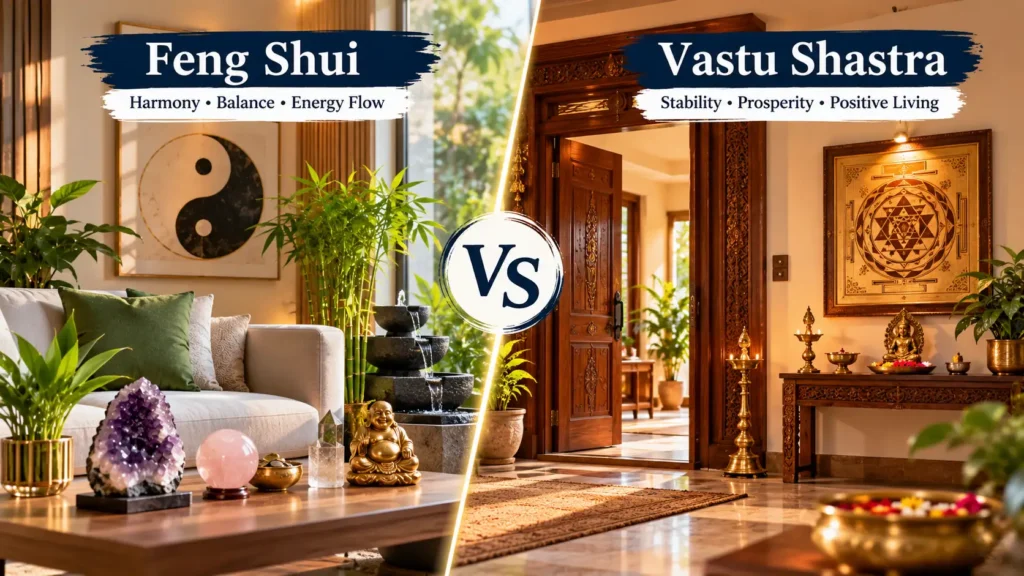
When people want to create a more balanced and harmonious home, two traditional systems often come up: Feng Shui and Vastu Shastra. Both are associated with the arrangement of spaces, directions, elements and the relationship between people and their surroundings. However, they developed in different cultural traditions and use different concepts and methods.
Feng Shui originated in China and traditionally focuses on the flow and balance of qi (chi) within an environment. Vastu Shastra developed within the Indian architectural tradition and places considerable emphasis on directions, spatial planning, natural elements and the relationship between a structure and its surroundings.
Although both systems are sometimes discussed together, Feng Shui and Vastu Shastra are not the same system.
Understanding their similarities and differences can help homeowners decide which traditional approach, or combination of ideas, fits their home and personal beliefs.
Table of Contents
What Is Feng Shui?
Feng Shui is a traditional Chinese practice concerned with the arrangement of spaces and the relationship between people and their environment.
The term is commonly translated as “wind-water,” reflecting the importance traditionally given to natural forces and environmental conditions.
A major concept in Feng Shui is qi (chi), often described as life energy or vital energy. Traditional Feng Shui aims to create a balanced environment where qi can move appropriately through a space.
Depending on the school of Feng Shui, practitioners may consider factors such as:
- Direction and orientation
- Room arrangement
- Entrance placement
- Furniture positioning
- Five elements
- Yin and yang
- Shapes and forms
- Natural surroundings
- Symbolic objects
- Colours and materials
For example, a Feng Shui-inspired living room may use natural materials, plants, balanced furniture placement and carefully selected decorative elements to create a calm and harmonious atmosphere.
It is important to remember that Feng Shui is a traditional cultural practice rather than a scientifically established method for guaranteeing wealth, health or other outcomes.
What Is Vastu Shastra?
Vastu Shastra is a traditional Indian architectural and spatial-planning system. Its concepts appear in historical Indian texts concerned with architecture, buildings and the organisation of living spaces.
Vastu traditionally considers the relationship between a building, its orientation, directions, proportions, elements and surrounding environment.
The four primary directions—north, south, east and west—along with the intermediate directions are important in many Vastu interpretations.
Traditional Vastu concepts may consider:
- Plot orientation
- Main entrance
- Room placement
- Directional zones
- Five elements
- Natural light and ventilation
- Spatial proportions
- Centre of the home
- Symbolic and spiritual elements
Modern homeowners sometimes use selected Vastu principles while designing houses, offices, shops and other spaces.
Like Feng Shui, Vastu is rooted in traditional beliefs and architectural philosophy. Specific recommendations can vary depending on the particular Vastu tradition or practitioner.
Feng Shui vs Vastu: Key Differences
The biggest difference between Feng Shui and Vastu Shastra is their cultural origin and underlying framework.
Feng Shui developed in China, while Vastu Shastra developed in India.
| Feature | Feng Shui | Vastu Shastra |
|---|---|---|
| Origin | China | India |
| Traditional focus | Balance and flow of qi | Spatial harmony, directions and natural principles |
| Cultural background | Chinese tradition | Indian architectural tradition |
| Directions | Important, depending on school | Strong emphasis on directional zones |
| Five elements | Wood, Fire, Earth, Metal, Water | Earth, Water, Fire, Air, Space |
| Home arrangement | Furniture, forms, flow and elements | Building orientation, rooms, directions and proportions |
| Symbolic objects | Crystals, coins, plants, mirrors and traditional symbols | Yantras, lamps, sacred symbols and traditional objects |
| Main entrance | Often considered an important qi entry point | Often considered important in relation to direction and placement |
| Modern use | Interior arrangement and environmental harmony | Architecture, home planning and interior arrangement |
Despite these differences, both traditions encourage people to think carefully about how a space is arranged.
Directions and Five Elements
One of the most interesting similarities between Feng Shui and Vastu is their attention to directions and elements.
However, the systems do not use exactly the same elements.
Five Elements in Feng Shui
The traditional Feng Shui five-element system includes:
- Wood
- Fire
- Earth
- Metal
- Water
These elements are associated with different qualities, forms, colours and symbolic relationships.
For example:
- Wood is traditionally associated with growth and expansion.
- Fire represents activity and transformation.
- Earth is associated with stability.
- Metal is linked with structure and clarity.
- Water is associated with movement and flow.
Feng Shui practitioners may use colours, materials, shapes and objects to represent these elements within a space.
Five Elements in Vastu
Vastu traditionally works with Pancha Mahabhuta, or five great elements:
- Earth (Prithvi)
- Water (Jal)
- Fire (Agni)
- Air (Vayu)
- Space (Akasha)
These elements are traditionally considered part of the natural environment and are incorporated into Vastu concepts relating to buildings and spaces.
Why the Difference Matters
Although both systems use the idea of five elements, their elements are not identical.
Feng Shui uses Wood and Metal, whereas the Vastu framework includes Air and Space.
Therefore, a person should not assume that a Feng Shui element chart can simply be transferred into a Vastu system.
Feng Shui, Vastu and the Main Entrance
The main entrance is an important consideration in both traditions, although the reasoning and recommendations can differ.
In Feng Shui, the front door is traditionally considered an important point through which qi enters a home. Keeping the entrance clean, accessible, well maintained and welcoming is therefore commonly emphasised.
In Vastu, the entrance is also traditionally considered significant, with direction, placement and surrounding spaces receiving considerable attention.
For homeowners, some practical principles work well regardless of which tradition they follow:
- Keep the doorway clean.
- Avoid unnecessary clutter.
- Make sure the door opens properly.
- Maintain adequate lighting.
- Keep the pathway accessible.
- Avoid storing excessive items at the entrance.
- Choose decor that complements the home.
- Keep plants healthy and well maintained.
These steps can improve the appearance and functionality of an entrance without requiring the homeowner to follow every traditional rule.
Crystals, Yantras and Traditional Objects
Decorative and symbolic objects are commonly associated with both modern Feng Shui and Vastu-inspired interiors.
However, the types of objects and their traditional meanings can differ.
Crystals in Feng Shui-Inspired Decor
Crystals are popular in modern Feng Shui-inspired interiors.
Commonly used crystals include:
- Clear Quartz
- Amethyst
- Citrine
- Rose Quartz
- Black Tourmaline
- Tiger Eye
- Green Aventurine
People may select crystals according to traditional symbolism, colour or personal preference.
For example, Citrine is often associated in modern crystal and Feng Shui-inspired decor with abundance and prosperity, while Amethyst is commonly associated with calmness and spiritual symbolism.
These associations are traditional or symbolic rather than scientifically proven effects.
Yantras in Vastu-Inspired Spaces
Yantras are sacred geometric diagrams traditionally associated with Hindu spiritual practices.
Different yantras have different traditional meanings and associations. Depending on personal beliefs, they may be displayed in homes, prayer spaces, offices or other environments.
Examples include:
- Shri Yantra
- Kuber Yantra
- Vastu Purusha Yantra
- Ashta Lakshmi Yantra
- Kanakdhara Yantra
When using a yantra, people who follow traditional practices may pay attention to its placement, orientation, cleanliness and method of worship or installation.
Feng Shui Decor and Vastu Yantras: Can They Be Used Together?
Some homeowners use Feng Shui-inspired objects and Vastu products in the same home.
There is no universal traditional rule that requires every homeowner to choose only one decorative philosophy. However, combining objects without understanding their intended symbolism can make the space unnecessarily complicated.
A better approach is to select a small number of meaningful pieces.
For example, a home might feature:
- A crystal on a console table
- A healthy indoor plant
- A traditional Indian artwork
- A Vastu yantra in an appropriate spiritual area
- Natural wood or stone decor
- Simple lighting
The emphasis should remain on balance rather than quantity.
Can You Follow Both Feng Shui and Vastu?
Yes, some homeowners choose to incorporate selected ideas from both Feng Shui and Vastu.
However, it is important to understand that they are separate traditional systems.
Instead of trying to apply every rule from both systems simultaneously, homeowners can focus on principles that are compatible with their lifestyle and home design.
For example, both approaches can inspire you to:
- Keep your home organised.
- Make better use of natural light.
- Create comfortable pathways.
- Introduce natural materials.
- Maintain a welcoming entrance.
- Avoid unnecessary clutter.
- Create visual balance.
- Use meaningful decorative elements.
These practical design principles can be followed without creating conflicts between the two traditions.
When Combining Both Systems May Become Confusing
Problems can arise when two systems provide different recommendations for the same space.
For instance, a particular direction or object may have different traditional interpretations in Feng Shui and Vastu.
In such cases, homeowners can choose one framework as their primary approach rather than trying to satisfy every rule simultaneously.
If the project involves major architectural decisions, it may also be useful to consult a qualified professional familiar with the specific tradition being followed.
Feng Shui vs Vastu for Different Areas of the Home
Different rooms can be approached through either tradition, but the emphasis varies.
Living Room
A Feng Shui-inspired living room may focus on comfortable furniture placement, movement through the room, natural elements and visual balance.
A Vastu-inspired living room may consider the room’s location within the house, orientation and traditional directional principles.
For both approaches, adequate lighting, ventilation and comfortable furniture can improve the room.
Bedroom
Feng Shui often gives attention to bed placement, balance and creating a calm environment.
Vastu may consider bedroom location, orientation and traditional directional associations.
Regardless of the system, reducing clutter and creating a relaxing sleeping environment is practical.
Kitchen
Feng Shui traditionally considers the relationship between elements, particularly Fire and Water.
Vastu also gives significant importance to the kitchen and its relationship with directions and the fire element.
Good ventilation, safe appliance placement and cleanliness should remain priorities.
Entrance
Both traditions attach importance to the entrance, although their frameworks differ.
A clean doorway, good lighting, functional hardware and an uncluttered pathway are useful from a practical home-design perspective.
Which Is Better: Feng Shui or Vastu?
There is no universally correct answer to whether Feng Shui or Vastu is better.
They are different traditional systems developed in different cultural contexts.
Your choice may depend on:
- Cultural background
- Personal beliefs
- Type of property
- Existing home layout
- Interior design preferences
- Whether you are building or renovating
- Which traditional framework you are more comfortable following
If you are primarily interested in Chinese traditions and the concept of qi, Feng Shui may be more relevant to you.
If you are interested in Indian architectural traditions, directions, Pancha Mahabhuta and Vastu principles, Vastu Shastra may be more suitable.
Some people simply use ideas from both as inspiration for creating organised and aesthetically pleasing homes.
Practical Tips for a Balanced Home
Whether you follow Feng Shui, Vastu or neither system strictly, several basic design practices can make a home more comfortable.
Keep Clutter Under Control
Regularly remove items you no longer use. Clear surfaces and organised storage can make rooms feel more spacious.
Improve Natural Light
Where practical, allow natural light into living areas. Use curtains and furniture arrangements that do not unnecessarily block windows.
Add Natural Elements
Indoor plants, wooden furniture, stone surfaces and natural fabrics can introduce texture and warmth.
Maintain Good Ventilation
Fresh air and appropriate ventilation contribute to a more comfortable indoor environment.
Choose Decor Carefully
Instead of filling every corner with symbolic objects, select pieces that genuinely complement your space.
Keep the Entrance Welcoming
A clean entrance, functional door, suitable lighting and an organised shoe-storage solution can make a significant difference.
Final Thoughts
Feng Shui and Vastu Shastra are two different traditional systems that explore how people interact with their built environments.
Feng Shui comes from the Chinese tradition and commonly focuses on qi, balance, forms, directions and the five-element system of Wood, Fire, Earth, Metal and Water.
Vastu Shastra comes from the Indian architectural tradition and places strong emphasis on directions, spatial planning and the five great elements—Earth, Water, Fire, Air and Space.
Both traditions have influenced modern home design, and both can provide ideas for creating spaces that feel organised, intentional and harmonious.
If you want to incorporate traditional products into your home, consider choosing Vastu yantras, Feng Shui-inspired decor, crystals or other symbolic objects according to your personal beliefs and the overall design of the space.
Most importantly, traditional decor should complement the home rather than make it feel crowded. A thoughtful combination of cleanliness, natural light, organisation, functionality and meaningful decor can create a home that feels comfortable and welcoming.
Key Takeaway
Feng Shui and Vastu Shastra are not competing versions of the same system. They are distinct traditions with different origins, concepts and approaches to space.
Choose the principles that align with your beliefs and lifestyle, and combine traditional decor with practical elements such as good lighting, organisation, ventilation and comfortable design.
Frequently Asked Questions
Is Feng Shui the same as Vastu Shastra?
No. Feng Shui and Vastu Shastra are different traditional systems. Feng Shui developed in China, while Vastu Shastra developed within the Indian architectural tradition.
Which is better, Feng Shui or Vastu?
Neither can be considered universally better. The choice depends on your cultural background, personal beliefs, home design and the principles you prefer to follow.
Do Feng Shui and Vastu both use five elements?
Yes, both traditions have five-element concepts, but they are different. Feng Shui traditionally uses Wood, Fire, Earth, Metal and Water, while Vastu uses Earth, Water, Fire, Air and Space.
Can I use Feng Shui crystals in a Vastu home?
Some homeowners choose to use crystals as decorative or symbolic objects in homes that also follow Vastu principles. Their placement should be considered according to the particular tradition and personal preference.
Can I keep a Vastu Yantra and Feng Shui decor together?
Yes, some people combine them. However, it is better to use a limited number of meaningful objects and understand their traditional significance rather than overcrowding the space.
Is Feng Shui scientifically proven?
Feng Shui is a traditional cultural practice and is not scientifically established as a method for guaranteeing wealth, health, luck or other outcomes. Many people use its principles for cultural, symbolic or interior-design reasons.
Is Vastu Shastra scientifically proven?
Vastu Shastra is a traditional Indian architectural and spatial-planning system. Its spiritual and symbolic claims are not established as scientific guarantees. Some practical design principles associated with it may overlap with general considerations such as light, ventilation and spatial organisation.
Can Feng Shui and Vastu be followed together?
Yes, people may choose to incorporate selected ideas from both traditions. Because the systems have different principles, it is useful to understand each one separately and avoid applying conflicting rules without context.
What products can be used in a Feng Shui or Vastu-inspired home?
Depending on your preferences, you can use crystals, Feng Shui decorative objects, Vastu yantras, traditional lamps, plants, natural stones and other symbolic home decor.