

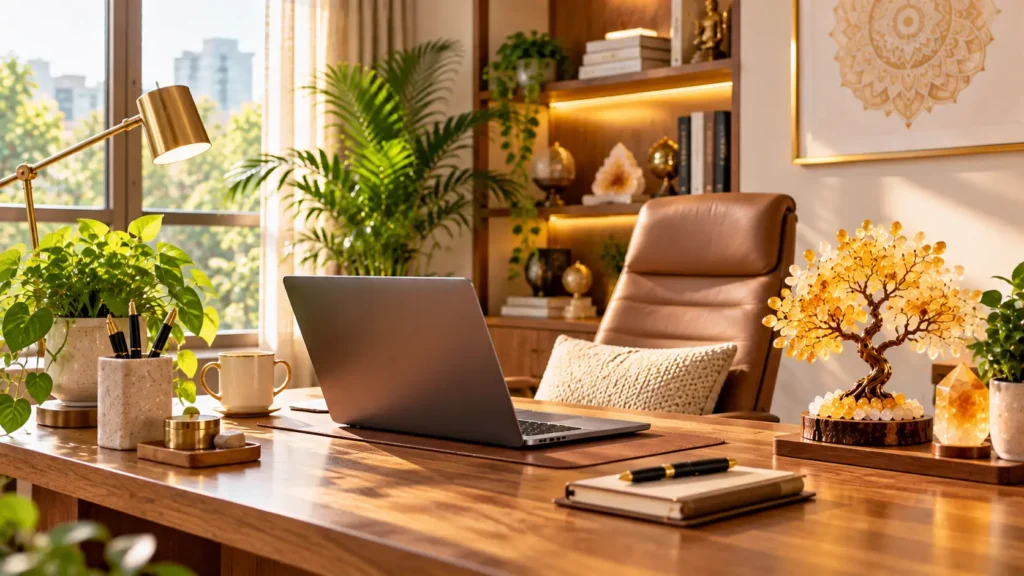
Your office is more than just a desk, computer and chair. The way your workspace is arranged can influence how comfortable, organised and focused the room feels throughout the day.
This is where Feng Shui for office becomes interesting.
Feng Shui is a traditional Chinese spatial practice that focuses on the relationship between people and their surrounding environment. In office settings, practitioners commonly pay attention to desk placement, the position of the entrance, open space, clutter, natural elements and symbolic objects.
One of the best-known ideas is the command position: placing the desk so that you can see the room’s entrance while seated, while ideally having solid support behind you and avoiding sitting directly in line with the door.
You don’t need to completely redesign your office to explore these principles. A few thoughtful changes—such as repositioning your desk, clearing unnecessary clutter, improving lighting and adding meaningful natural elements—can make a workspace feel much more intentional.
Let’s look at how to apply these ideas to a modern office or home workspace.
Table of Contents
What Is Office Feng Shui?
Office Feng Shui is the application of traditional Feng Shui principles to a workplace.
The basic idea is to create a space that feels balanced, supported and easy to use. Traditional Feng Shui uses concepts such as qi, spatial relationships and the five elements, while modern interpretations often combine these ideas with interior design and practical workspace organisation.
For an office, this can mean paying attention to:
- Where your desk is positioned
- What is behind your chair
- Whether you can see the entrance
- How easily you can move around the room
- How much clutter is present
- Where natural light enters
- How plants and decorative objects are used
- Whether the workspace visually supports your purpose
A useful way to approach Feng Shui is not to think of it as a promise of instant success or wealth. Instead, consider it a traditional design framework for creating a more intentional workspace.
This distinction matters because Feng Shui does not scientifically guarantee promotions, business growth, wealth or productivity.
Best Desk Position for a Workspace
If you want to make just one change based on traditional office Feng Shui, start with your desk.
The command position is one of the most frequently discussed principles in modern Feng Shui office guidance.
The basic arrangement is:
- You can see the office entrance while seated.
- Your back has solid support, ideally a wall.
- You are not sitting directly in the doorway’s line.
- There is comfortable open space in front of your desk.
- The desk does not block natural movement through the room.
Traditional Feng Shui sources describe this as a stronger and more supported position for working.
Why avoid sitting directly in front of the door?
In traditional Feng Shui, the direct line between the entrance and the desk is often considered less desirable because of the strong flow associated with an entrance.
From a practical interior-design perspective, a diagonal position can also make sense. You can maintain awareness of the entrance without having the doorway directly in front of you.
What if your desk cannot be moved?
Not every office has the perfect layout.
If your desk is against a wall or your room is too small to create a textbook command position, don’t force the arrangement.
Try these alternatives:
- Turn the desk slightly so the entrance becomes visible.
- Use a small mirror to improve awareness of the doorway if appropriate.
- Keep the area behind your chair visually stable.
- Use a substantial bookcase or cabinet where a solid wall is unavailable.
- Keep the space immediately around your chair uncluttered.
The goal should be to improve the overall feeling and functionality of the workspace rather than obsess over achieving a perfect Feng Shui diagram.
Should Your Office Desk Face the Door?
Not necessarily.
A common misunderstanding is that Feng Shui requires the desk to face the door directly.
The more commonly described command position allows you to see the door without being directly aligned with it. A diagonal view is often preferred.
For example, imagine a rectangular office:
Less desirable layout:
Door → Desk → Person
More commonly recommended layout:
Door → open space
Desk ↗
Person with solid support behind
This arrangement gives you a view of the entrance while keeping the desk away from the direct path through the doorway.
How to Organise Your Office
A beautiful Feng Shui office can still feel uncomfortable if the desk is buried under paperwork.
Clutter is therefore one of the easiest areas to address.
Traditional Feng Shui places importance on clear, balanced spaces, and modern workspace design also benefits from keeping frequently used areas organised.
1. Keep your desk surface intentional
Your desk doesn’t need to be completely empty.
Instead, keep only items you regularly use or genuinely value.
For example:
- Laptop or monitor
- Notebook
- Pen holder
- One small plant
- One meaningful decorative object
- Water bottle
- Frequently used documents
Everything else can have a designated storage location.
2. Don’t let cables dominate the workspace
Messy cables can make even an expensive office look chaotic.
Use:
- Cable clips
- Under-desk cable management
- A charging station
- Wireless accessories where practical
This is both a Feng Shui-friendly design choice and a simple way to make your office visually cleaner.
3. Give important objects a permanent place
If you repeatedly search for the same documents, charger or stationery, the problem isn’t necessarily your memory—it may be the organisation system.
Create specific locations for:
- Important documents
- Stationery
- Electronics
- Bills
- Business paperwork
- Personal items
A clear system reduces visual and physical friction.
Lighting Matters in a Feng Shui Office
Lighting is often discussed through the lens of atmosphere in Feng Shui, but it also has a straightforward practical role in a computer workspace.
Try to make use of natural daylight where possible without creating glare on your screen.
For computer work, OSHA recommends positioning monitors to reduce glare and suggests placing the monitor perpendicular to a window. It also recommends considering viewing distance, height and angle to reduce awkward posture and visual discomfort.
A balanced office lighting setup can include:
- Natural daylight
- Soft ambient lighting
- A task lamp when necessary
- Controlled screen brightness
- Curtains or blinds to manage excessive sunlight
Avoid positioning your monitor where strong sunlight or artificial lighting reflects directly into the screen.
A workspace can look beautiful while still being uncomfortable to work in. Function should always come first.
Add Natural Elements to Your Office
Plants are one of the easiest ways to introduce a natural element into an office.
You don’t need a large indoor garden.
A single healthy plant on a shelf or beside the desk can add visual softness to an otherwise technology-heavy environment.
Good options include:
- Money plant
- Jade plant
- Areca palm
- Snake plant
- Pothos
- Other indoor plants suited to your room’s light conditions
The key is maintenance.
A healthy plant supports a pleasant environment; a neglected, dying plant can simply become another source of visual clutter.
Traditional Wealth Corner Ideas for an Office
The concept of a wealth or prosperity corner is popular in modern Feng Shui.
However, there isn’t one universal placement rule that applies to every Feng Shui school. Bagua-based approaches and classical systems can interpret directions and sectors differently.
For that reason, avoid presenting a particular corner as a scientifically proven “money zone.”
Instead, you can use the idea as a symbolic area for financial goals, business intentions and prosperity-themed decor.
What can you place there?
Depending on your personal style, you might use:
- A healthy green plant
- Citrine crystal
- Crystal tree
- Meaningful artwork
- A small prosperity-themed decorative item
- A written business goal
- A neatly displayed achievement or certificate
The important part is intentionality and organisation.
Don’t turn the corner into a collection of random “lucky” objects.
A single well-placed object can look much more sophisticated than a crowded shelf.
Crystals for Office Decor
Crystals are commonly incorporated into modern Feng Shui-inspired interiors.
Their traditional or spiritual meanings vary depending on the crystal tradition, practitioner and cultural context. They should therefore be treated as symbolic decor rather than scientifically proven tools for changing financial or professional outcomes.
Here are some popular choices.
Citrine
Citrine is frequently associated with prosperity, abundance and confidence in modern crystal practices.
A small Citrine cluster, crystal tree or Citrine bracelet can work as a symbolic reminder of financial goals and positive intentions.
For a professional office, keep the styling subtle rather than filling the desk with multiple crystal objects.
Clear Quartz
Clear Quartz is commonly associated with clarity and intention in crystal traditions.
It can work well as a minimalist decorative piece on a desk or shelf.
Amethyst
Amethyst is often associated with calmness and spiritual awareness in modern crystal practices.
A small Amethyst cluster can complement a quiet reading or planning corner.
Tiger Eye
Tiger Eye is commonly associated with confidence, courage and grounded energy in crystal traditions.
Its earthy brown and golden appearance also works particularly well with wooden office furniture.
Crystal Tree
A crystal tree combines the visual symbolism of a tree with gemstone decoration.
It can be placed on:
- A bookshelf
- Side cabinet
- Console
- Office shelf
- Meeting-room side table
- Home-office corner
A Citrine crystal tree is particularly popular in prosperity-themed decor.
Again, think of the object as a symbolic and decorative element—not a guaranteed financial remedy.
How to Use a Citrine Bracelet in the Office
A Citrine bracelet can be incorporated into an office routine without making the workspace look overly spiritual.
You can wear it while working or keep it in a small designated space when you’re not wearing it.
Some people choose Citrine because of its traditional association with abundance and prosperity.
For a professional environment, the simplest approach is often best.
Pair it with:
- A clean desk
- Neutral accessories
- A small plant
- Minimal crystal decor
- A clear personal goal
The bracelet becomes a visual reminder of the intention behind your work rather than something expected to produce an automatic result.
Feng Shui Office Colors
Colour is another area where Feng Shui and interior design overlap.
Rather than searching for one “lucky office colour,” consider the mood you want the room to create.
Neutral colours
White, cream, beige and soft grey can create a clean visual background.
Green
Green works naturally with plants and can introduce a fresh, organic feeling.
Blue
Soft blue can create a calm visual atmosphere and works particularly well in modern offices.
Earth tones
Brown, tan, terracotta and warm beige pair naturally with wooden furniture and crystal decor.
Gold accents
Small gold or brass accents can create a refined prosperity-inspired look without making the office feel excessive.
A good rule is to choose a calm base colour and use stronger colours through small accents.
What to Avoid in a Feng Shui Office
You don’t need to follow dozens of rules.
Focus on the problems that actually affect the room.
1. Desk directly facing a wall
A desk pushed against a blank wall may be unavoidable in a tiny room, but if you have flexibility, try creating more visual space in front of you.
2. Back directly to the entrance
This is one of the most commonly mentioned Feng Shui office arrangements to reconsider. The traditional command-position approach favours being able to see the entrance.
3. Excessive clutter
Stacks of old paperwork, unused electronics and miscellaneous objects can make the workspace feel crowded.
4. Dead or neglected plants
Choose plants you can realistically maintain.
5. Too many symbolic objects
More Feng Shui objects don’t automatically create better Feng Shui.
Choose a few meaningful pieces.
6. Screen glare
This is a practical issue rather than a Feng Shui belief. Reflections and poor monitor placement can contribute to visual discomfort and awkward working positions.
7. Poor ergonomics
A beautiful office still needs a comfortable chair, suitable monitor height, proper keyboard positioning and enough room to move.
OSHA’s workstation guidance specifically highlights monitor position, viewing distance, posture and glare as factors worth checking in computer workstations.
Feng Shui for a Small Home Office
You don’t need a dedicated room.
A small work-from-home setup can still follow the basic principles.
If you’re working from a bedroom, living room or dining area, try creating a visual boundary between work and personal life.
For example:
Small corner office setup:
- Compact wooden desk
- Comfortable ergonomic chair
- Desk lamp
- Small indoor plant
- Citrine crystal or crystal tree
- Cable organiser
- Closed storage box
- Neutral wall background
When work ends, clear the desk and put away work-related objects where possible.
This creates a stronger psychological separation between working hours and personal time.
Feng Shui Office Setup for Business Owners
If you run a business from home, your office can also become a visual reminder of your business goals.
Consider creating three zones:
1. Work Zone
This is where your laptop, monitor, documents and daily tools stay.
Keep it functional.
2. Planning Zone
Use a notebook, calendar, whiteboard or planning board for:
- Business goals
- Marketing plans
- Important deadlines
- Monthly targets
3. Inspiration Zone
This can include:
- Crystal tree
- Citrine
- Meaningful artwork
- Awards
- Certificates
- Brand milestones
- Personal vision board
This approach makes the space feel personal without turning it into a showroom of Feng Shui objects.
Home Office Feng Shui Checklist
Before you finish arranging your workspace, ask yourself:
Desk
- Can I see the entrance from my chair?
- Is my back supported by a wall or substantial furniture?
- Am I avoiding the direct path of the doorway?
- Do I have enough space in front of my desk?
Organisation
- Is my desk reasonably clutter-free?
- Do important items have designated places?
- Are cables organised?
- Is unnecessary paperwork stored away?
Lighting
- Do I have enough natural or artificial light?
- Is there glare on my monitor?
- Is my monitor positioned comfortably?
- Can I work without constantly squinting?
Decor
- Do I have at least one natural element?
- Are my plants healthy?
- Are my crystals or Feng Shui items intentionally placed?
- Does the decor feel balanced rather than crowded?
Comfort
- Is my chair comfortable?
- Is my monitor at a suitable height?
- Can I maintain a neutral working posture?
- Can I move comfortably around the workspace?
How to Create a Modern Feng Shui Office
You don’t have to choose between traditional Feng Shui and contemporary interior design.
They can work together.
Imagine a modern Indian home office with:
- Warm wooden desk
- Cream or beige walls
- Comfortable ergonomic chair
- Laptop positioned to minimise glare
- Green indoor plant
- Small Citrine crystal tree
- Citrine bracelet
- Minimal stationery
- Closed storage
- Soft warm lighting
- One meaningful artwork
The result can feel sophisticated, calm and professional without looking excessively themed.
For crystal and Feng Shui-inspired decor, you can explore the collection at Namaveda and choose pieces that genuinely suit your workspace and personal style.
Final Thoughts
Feng Shui for office doesn’t have to mean filling your workspace with lucky objects or following a complicated list of rules.
Start with the basics.
Position your desk so you have a comfortable relationship with the entrance. Where possible, create solid support behind your chair and keep open space in front. Remove unnecessary clutter, improve lighting, organise your cables and make sure your computer setup is comfortable.
Then add decorative elements that have meaning for you.
A Citrine bracelet, crystal tree, indoor plant or carefully selected Feng Shui item can become part of that environment as a symbolic reminder of your goals and intentions.
Most importantly, don’t sacrifice functionality for symbolism.
The best workspace is one that feels organised, comfortable and purposeful—and gives you a place where you can do your actual work with fewer distractions.
Important Note
Feng Shui is a traditional cultural and spatial practice. Crystal meanings, prosperity associations and symbolic placement recommendations are based on traditional or modern spiritual beliefs and should not be interpreted as scientifically proven methods for guaranteeing wealth, career success, productivity or other outcomes.
For computer work, ergonomic and lighting recommendations should take priority over decorative or spiritual considerations.
Frequently Asked Questions About Feng Shui for Office
What is the best Feng Shui position for an office desk?
The commonly recommended position is the command position: you can see the entrance while seated, your back has solid support, and you are not directly in line with the doorway.
Should my office desk face the door?
It doesn’t have to face the door directly. Traditional Feng Shui guidance commonly favours a position where the entrance is visible without placing the desk directly in the doorway’s path.
What direction is best for an office desk in Feng Shui?
There is no single universal direction that applies to every person and every Feng Shui system. Desk placement should first consider the command position and the practical layout of the room. More specialised Feng Shui systems may use additional calculations.
Is Citrine good for an office?
Citrine is commonly used in modern crystal and Feng Shui-inspired decor because it is traditionally associated with prosperity and abundance. It should be viewed as symbolic decor rather than a scientifically proven method for creating wealth.
Where should I keep a crystal tree in my office?
A crystal tree can be placed on a shelf, side cabinet, console or another clean area where it is visible without interfering with work. If you use it as prosperity symbolism, keep it in a deliberate, uncluttered area.
Can I use Feng Shui in a small home office?
Yes. You can adapt the principles to almost any workspace. Prioritise desk position, clear movement, organisation, lighting and comfort rather than trying to recreate a large traditional office.
Is it bad Feng Shui to sit with your back to the door?
In traditional Feng Shui, sitting with your back directly to the entrance is generally considered less desirable. The command position instead emphasises being able to see the entrance while seated.
Which crystal is best for office prosperity?
Citrine is one of the most commonly associated crystals for prosperity in modern crystal practices. Tiger Eye is also popular for its traditional associations with confidence and groundedness.
Can plants improve office Feng Shui?
Plants are commonly used to introduce natural elements into Feng Shui-inspired spaces. Practically, they can also add visual interest and soften a technology-heavy office. Choose plants that suit the available light and that you can maintain properly.
Does Feng Shui actually increase productivity?
There is not strong scientific evidence that Feng Shui itself guarantees increased productivity. However, several workspace principles commonly recommended alongside Feng Shui—such as reducing clutter, managing glare and creating a comfortable computer setup—are practical design considerations. OSHA specifically recommends checking monitor position, glare, viewing distance and posture in computer workstations.
Can I use Feng Shui in a corporate office?
Yes. You can apply the ideas without making the office visibly spiritual. Desk positioning, organisation, plants, lighting and balanced decor can all be incorporated into a professional environment.
What is the most important Feng Shui office tip?
If you want to start with one change, focus on the desk’s command position. Try to sit where you can see the entrance while having solid support behind you, without sitting directly in the doorway’s path.